
A storage bench can look perfectly organized until a guest sits down. Their feet may occupy the place where a drawer opens, while the bag they brought has no assigned position. The useful question is not only how much the bench stores, but what remains accessible during the arrival routine.
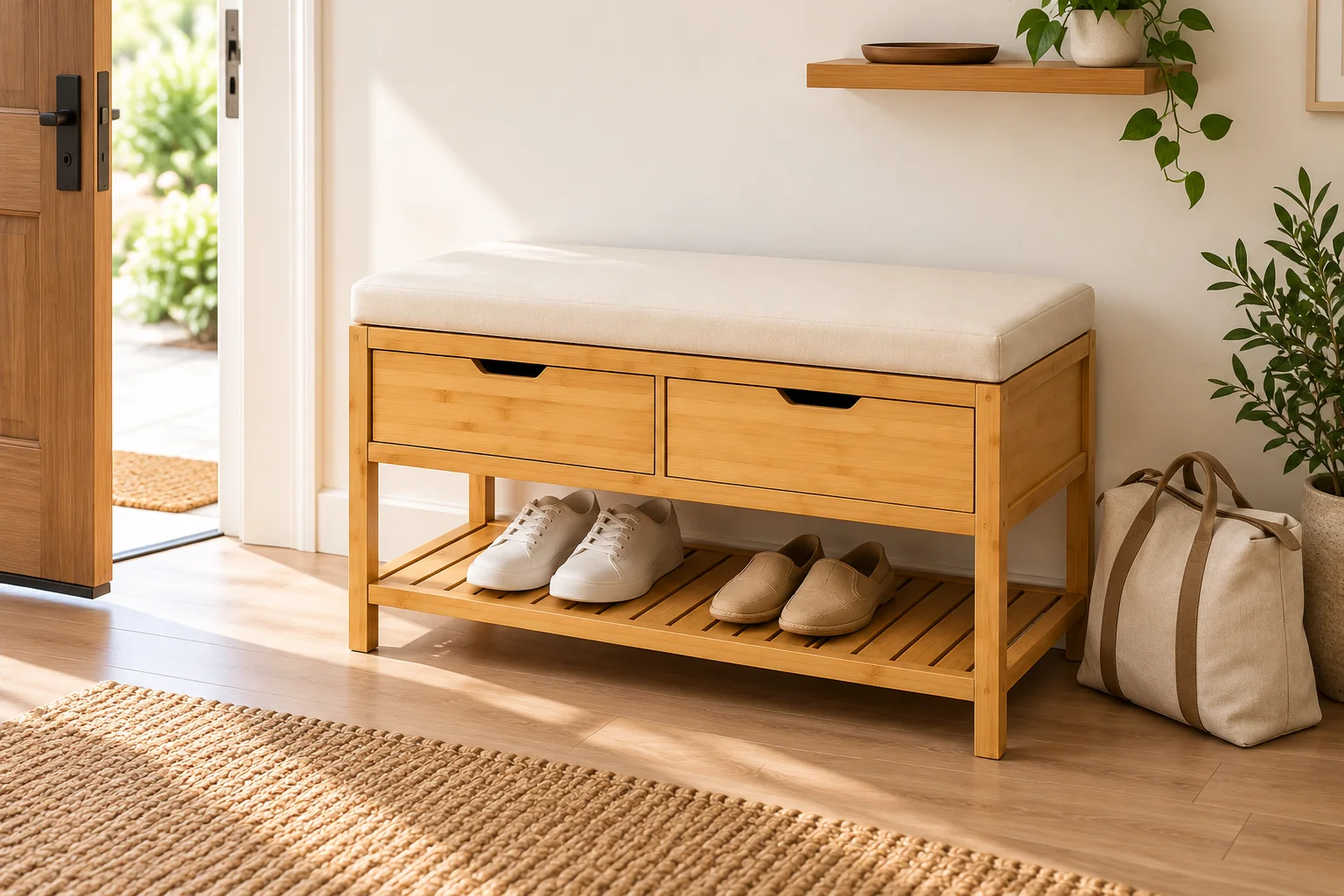
The Modern Bamboo Entryway Storage Bench combines an upholstered seat, two pull-out drawers and an open slatted lower shelf. Each storage zone should be given a job before its dimensions are finalized.
Walk through arrival in the right order
Use a trial sequence: open the room door, put down a bag, sit, change footwear, then put selected belongings away. This is a design exercise, not a reported guest study. At each step, note which surface or storage opening the person needs.
If the only place for a bag is the upholstered seat, decide what happens when the guest needs to sit there. If the drawers hold objects needed while seated, test how the person reaches them. A generous empty footprint does not resolve those conflicts.
Assign drawers and the lower shelf different contents
Pull-out drawers can conceal smaller items. The open shelf may suit selected footwear or baskets, subject to its approved dimensions and construction. Give the shelf actual objects to support; narrow heels, small feet on a basket or loose straps may interact differently with slat spacing.
Draw the drawer's movement while the bench is occupied. Clarify whether access is expected from the side, after standing up, or before sitting down. Do not make the layout depend on a user discovering the intended sequence by trial and error.
Keep hanging storage distinct from seating storage
The Piano-Key Functional Wall Panel offers individually concealed flip-out hooks as a separate wall-mounted direction. It can be discussed alongside an entry bench, but it is not an included bench accessory or a verified luggage-support system.
If hooks are proposed, check their opened position against the occupied bench and the door route. Identify the intended personal items and confirm their loading together with the wall fixings. A coat, a handbag and a suitcase are not interchangeable requirements.
Check the bench through an occupied-use trial
| Arrival action | Object or movement to include | Decision for the furniture brief |
|---|---|---|
| Putting a bag down | The intended bag in a designated position | Whether a separate landing place is needed |
| Sitting to change footwear | Occupied seat and feet moving in front | Seat use and lower-shelf access without relying on empty-room space |
| Opening a drawer | The actual opening path while someone is seated | Drawer purpose and the intended access sequence |
| Storing footwear | Selected shoes or baskets on the slatted shelf | Shelf opening, contact points and slat layout |
| Hanging an item | Opened hook, item and wall fixing direction | Separately confirmed hook use and its relationship to the bench |
Review the seat with the intended cleaning routine
Confirm whether the cushion is fixed or removable and obtain appropriate care instructions for the selected upholstery. The product allows these construction directions to be reviewed; it does not make a universal washable-cover claim.
For an entryway furniture discussion, provide the entry plan, door movement, the arrival sequence and assigned contents. Final seating loads, storage dimensions, hardware and any separate wall-mounted elements need project-specific approval.