
A swivel chair has more than one position in a room. The plan symbol may show it facing a table, while its back or arm moves towards a wall when someone turns. Choosing the chair by its stationary width and depth leaves that second footprint unexamined.
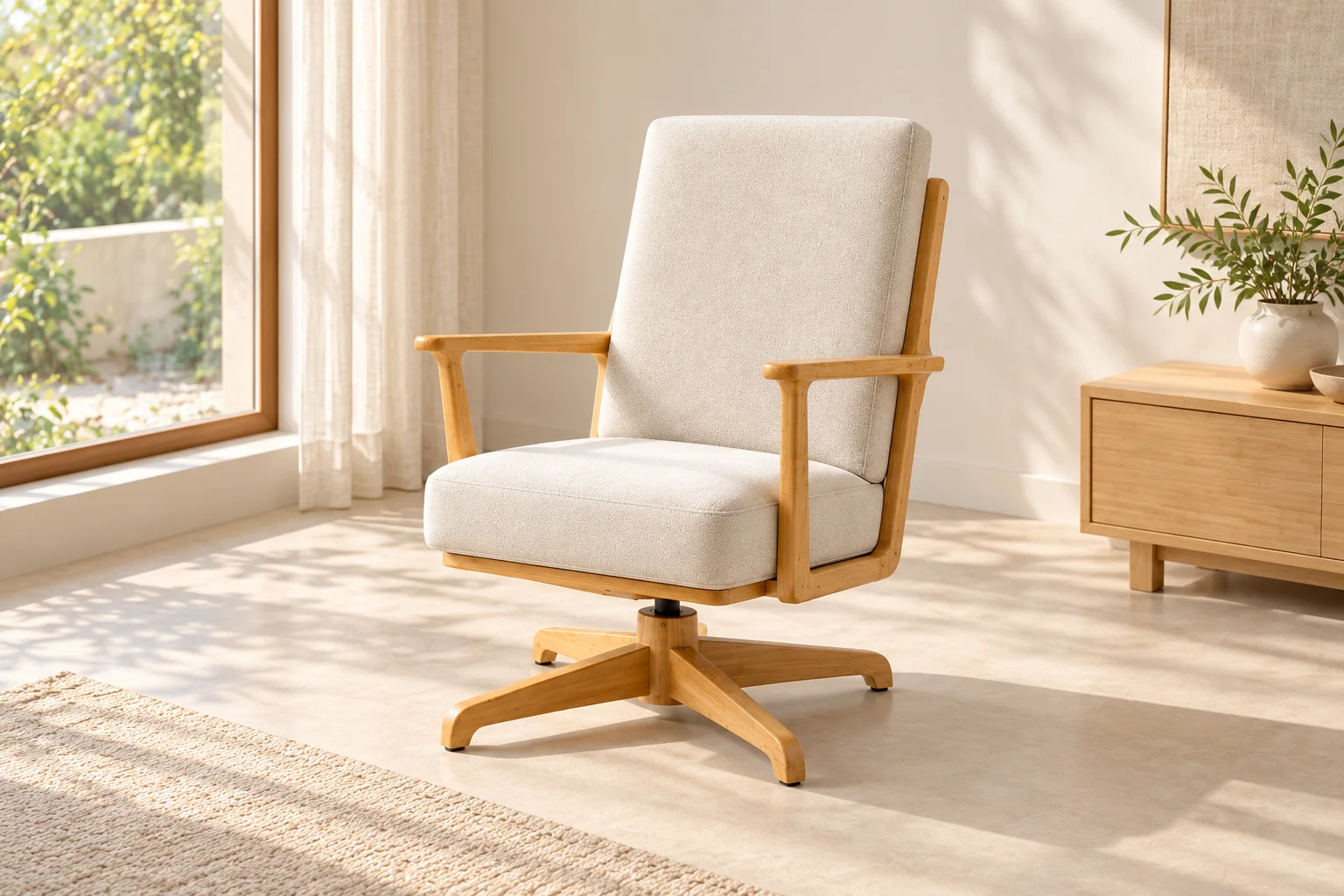
The Nordic Bamboo Swivel Lounge Chair is an upholstered, engineered-bamboo lounge seating direction. Its swivel details require project review. It is not a height-adjustable office task chair simply because it can turn.
Name the directions the chair needs to serve
On the room plan, mark what the seated user should be able to face: a companion, a view, a reading light or a different part of the lounge. These directions provide a reason for the swivel function. If the room requires only one fixed orientation, compare the benefit of movement with its additional specification needs.
Use the intended seated positions, not a promise that the user can reach everything without standing. A table that is convenient in one orientation may be behind the chair in another.
Draw the sweep of the occupied chair
Obtain the approved chair geometry and the swivel-axis position. Plot the furthest moving parts as the chair turns through the intended range. Include the user position, feet and any nearby object that must remain clear.
Check walls, side tables, lamps and curtains individually. A small base does not mean the whole chair turns inside the base's footprint. Nor does the nominal body width describe every rotated position. Room planning should use the proposed geometry rather than an estimated circle copied from another chair.
Specify the movement instead of assuming it
Confirm the permitted rotation range, whether the mechanism returns to a position, and any stops or restrictions. The published chair direction does not establish automatic return, full-circle rotation, reclining or a universal mechanism-load rating.
Ask how the selected mechanism is accessed for maintenance and how the finished chair is stabilized on the intended floor. Performance requirements need to be agreed for the actual construction and use, not transferred from a different product with a similar-looking base.
Compare the room positions and the mechanism together
| Item to review | What the plan or sample should show | What to confirm |
|---|---|---|
| Intended views | The seated directions that make turning useful | Which orientations the layout supports |
| Moving footprint | The approved chair geometry around its axis | Clearance to walls, tables, lighting and occupied routes |
| Rotation behavior | Selected swivel hardware and its operation | Range, stops and any return behavior without assumptions |
| Floor and stability | Intended floor condition and base contact | Agreed stability and loading requirements |
| Service access | Route to reach the selected mechanism | Maintenance instructions and genuinely replaceable parts |
Compare with fixed lounge seating if movement adds no value
The Engineered Bamboo Upholstered Armchair is a separate lounge-chair design reference without a published swivel feature. It can help a buyer compare a fixed seating direction, but its dimensions and construction are not interchangeable with the swivel chair's.
For a swivel lounge seating review, send the room position, intended facing directions and proposed movement requirements. Final chair size, mechanism, upholstery, construction and performance must follow the agreed project specification.