
The largest hidden compartment is not always the most useful one. Bedding reached occasionally and objects needed every evening make different demands on a storage bed. Decide how belongings will be retrieved before using capacity as the main comparison.
Divide contents by how often they are needed
List the proposed contents and separate frequent access from occasional storage. Use actual folded sizes or storage containers where possible. Then record whether the item is retrieved from beside the bed or through a raised platform.
This is an access decision, not a claim that a given bed accepts every container. Usable space depends on dividers, supporting members and the approved mechanism, not just the outer bed footprint.
Check drawers with the rest of the room in place
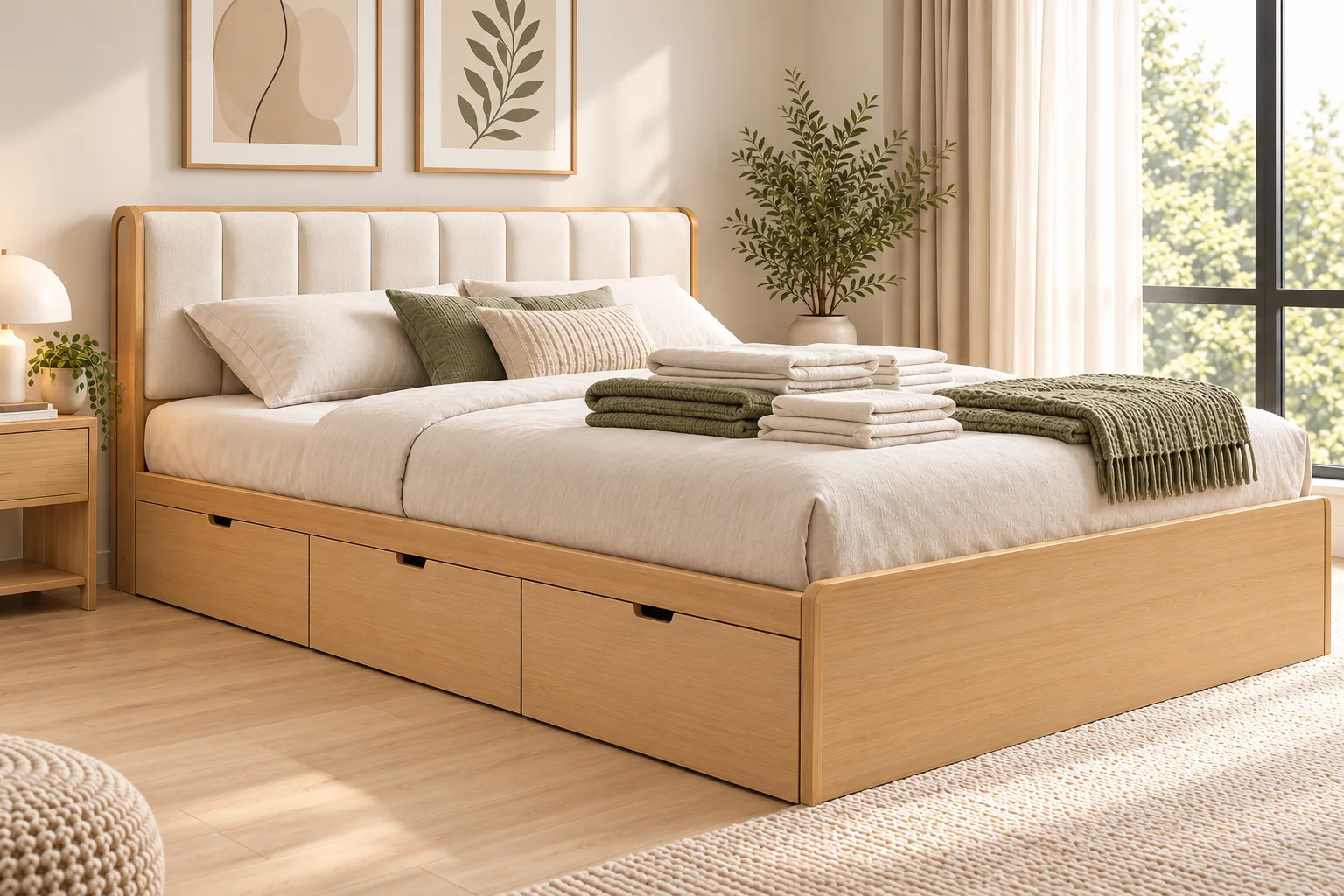
The Upholstered Storage Platform Bed provides an engineered-bamboo bed direction with integrated drawers. Drawer quantity, internal size and opening direction can be reviewed after structural assessment.
Draw the selected drawers fully open. Include adjacent wardrobes, bedside units and the space used by the person retrieving an item. A drawer may fit inside the closed bed while being blocked by furniture outside it. Decide the access side before treating additional drawers as an automatic improvement.
Match lift-up access to the actual platform assembly
The Lift-Up Storage Platform Bed combines lift-up under-bed compartments with pull-out storage. Its support hardware is selected against the final loading, size and construction; the design reference does not establish a standard mechanism suitable for every mattress.
Ask what moves, how it is operated and what instructions apply to the approved assembly. Confirm the relevant mattress and moving-platform specification with the furniture team. Do not infer that the bed can be left raised unattended, operated by children or supported by an improvised prop.
Compare storage through the retrieval action
| Access type | A useful planning question | What must be confirmed |
|---|---|---|
| Side or end drawers | Are frequently used objects reached from this side of the room? | Full opening path, user position and usable drawer interior |
| Lift-up compartment | Does occasional access suit the intended stored items? | Selected mechanism, moving assembly, operating instructions and surrounding space |
| Mixed drawers and lift-up storage | Which contents belong to each access method? | Internal divisions and whether each zone can be reached as intended |
| Any under-bed storage | Can the chosen object be inserted and removed? | Actual clear opening, obstructions and agreed loading |
Approve operation and maintenance separately from appearance
On a sample or an appropriate project-approved mechanism demonstration, review the relevant opening and closing actions. Request instructions for the selected hardware, safety provisions, maintenance and genuinely replaceable parts. A photograph of an open bed cannot establish those details.
Keep the requirements tied to the actual construction rather than prescribing an unsupported lifting capacity or cycle rating. If the mattress, drawer layout or mechanism changes, repeat the affected review instead of carrying the first approval over unchanged.
For a storage-bed specification discussion, provide the mattress information, room plan, stored-item list and preferred retrieval methods. Final compartment dimensions, hardware, operating instructions and performance follow the approved project documents.