
A five-drawer chest is not automatically more useful than a lower dresser with fewer drawers. Thin knitwear, folded shirts and bulky bedding occupy different shapes. Giving each group the same compartment can leave one drawer crowded and another mostly empty.
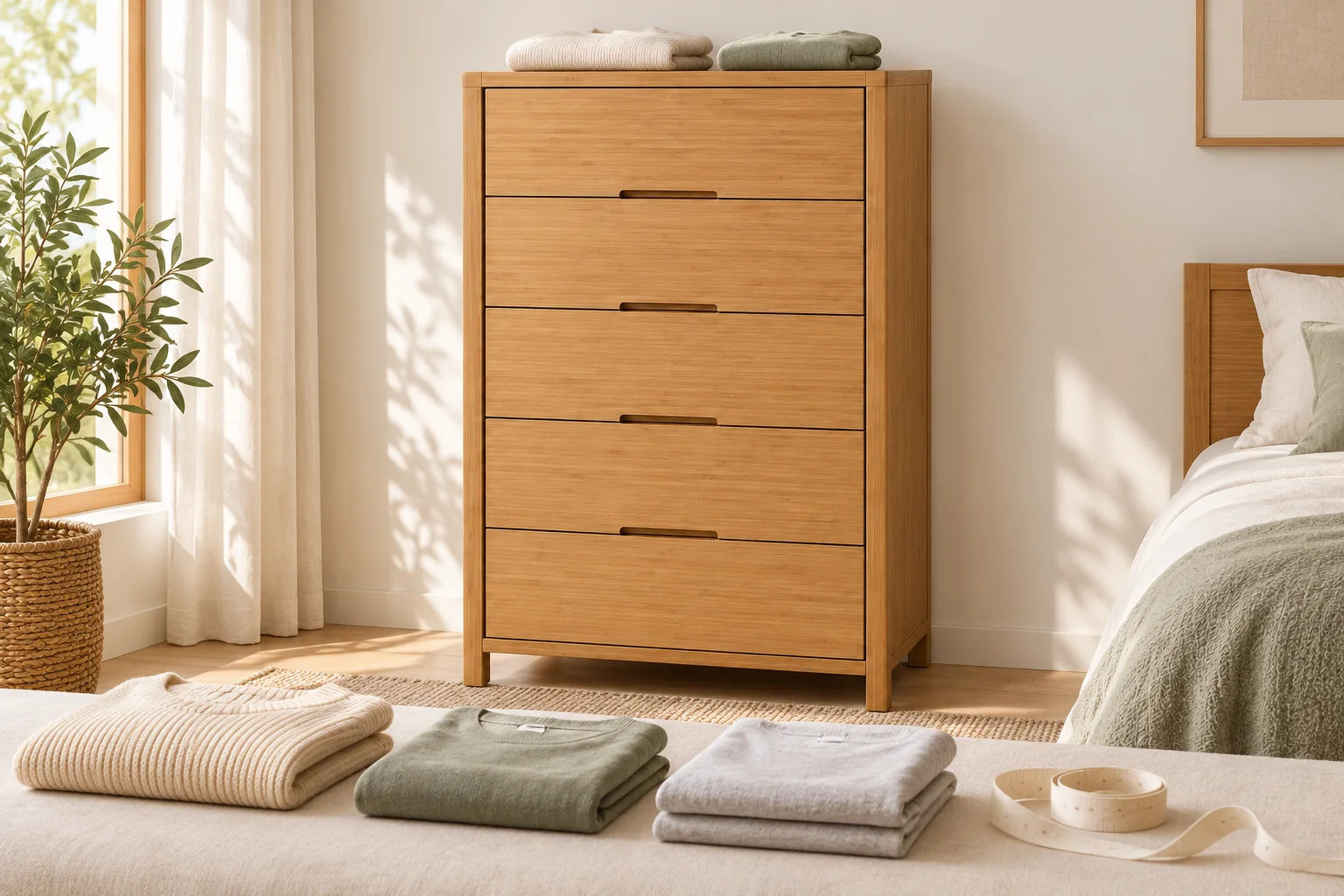
For a guestroom, apartment or residential furniture collection, make the drawer arrangement a clothing decision before making it a styling decision.
Start with a folded bundle
Use the way clothes will actually be folded. Measure a representative stack, including its folded width and depth, rather than relying on the garment's flat dimensions. Decide whether shirts will lie in piles or stand in rows, and whether several people need separate compartments.
A stack that fits a drawer box can still be difficult to retrieve if the upper items must be lifted out to reach the lower ones. Shallow, frequently accessed contents and bulky reserve items need not share one drawer depth.
Separate drawer count from usable storage
The Modern Bamboo 5-Drawer Chest provides a vertical five-drawer direction with recessed pulls. Its published customization scope includes drawer count, internal depth, dividers and runner specification. The page does not publish a fixed usable clothing capacity.
The Chest of Drawers Collection shows three-, four- and five-drawer design directions. These are a family of proportions, not identical boxes with different numbers of fronts. Ask for each proposed drawer's clear inside dimensions and its available opening with the selected runners.
Allocate compartments before choosing the front pattern
| Contents | Drawer decision | What to check on the sample |
|---|---|---|
| Folded shirts or knitwear | Rows or stacks, and their assigned compartment | Items can be seen and removed without disturbing the entire drawer |
| Socks and small garments | Whether dividers are useful | Divider positions suit the actual folded items |
| Bulky reserve textiles | A separately reviewed deeper drawer, if needed | The contents fit below the top edge and through the opening |
| Shared room storage | Separate user or use groups | The arrangement is understandable without a complicated labeling system |
This is a planning method, not a promise that a particular chest will hold every listed item. Drawer box construction, clearances and runner travel determine the final space. Known loading requirements should be reviewed with the supplier rather than inferred from the number of drawers.
Test the drawer at its normal opening
Place the proposed sample in the intended room position. Open a drawer, take out an item from the rear and close it again. Check where the user stands and whether a nearby bed or open wardrobe interferes.
Also review the recessed pull with the actual drawer front and proposed contents. Approving a runner option does not approve its installation or the complete drawer's operation. Stability and any required fixing or anti-tip provisions need a separate, destination-appropriate review.
Keep the clothing plan attached to the order
A useful inquiry identifies which drawer is intended for which contents, the required clear inside space, the selected hardware direction and the furniture's room position. That record is more informative than “five spacious drawers.”
Discuss a chest-of-drawers project with the preferred design reference and clothing plan. The bamboo material build, final dimensions, finish, hardware and safety details remain subject to the approved drawings, sample and project specification.