
An extra stool is easy to add to a room rendering. It is harder to give it a clear job. If it alternates between dressing seat, visitor seat and convenient place for a bag, the same object can be expected to do several incompatible things.
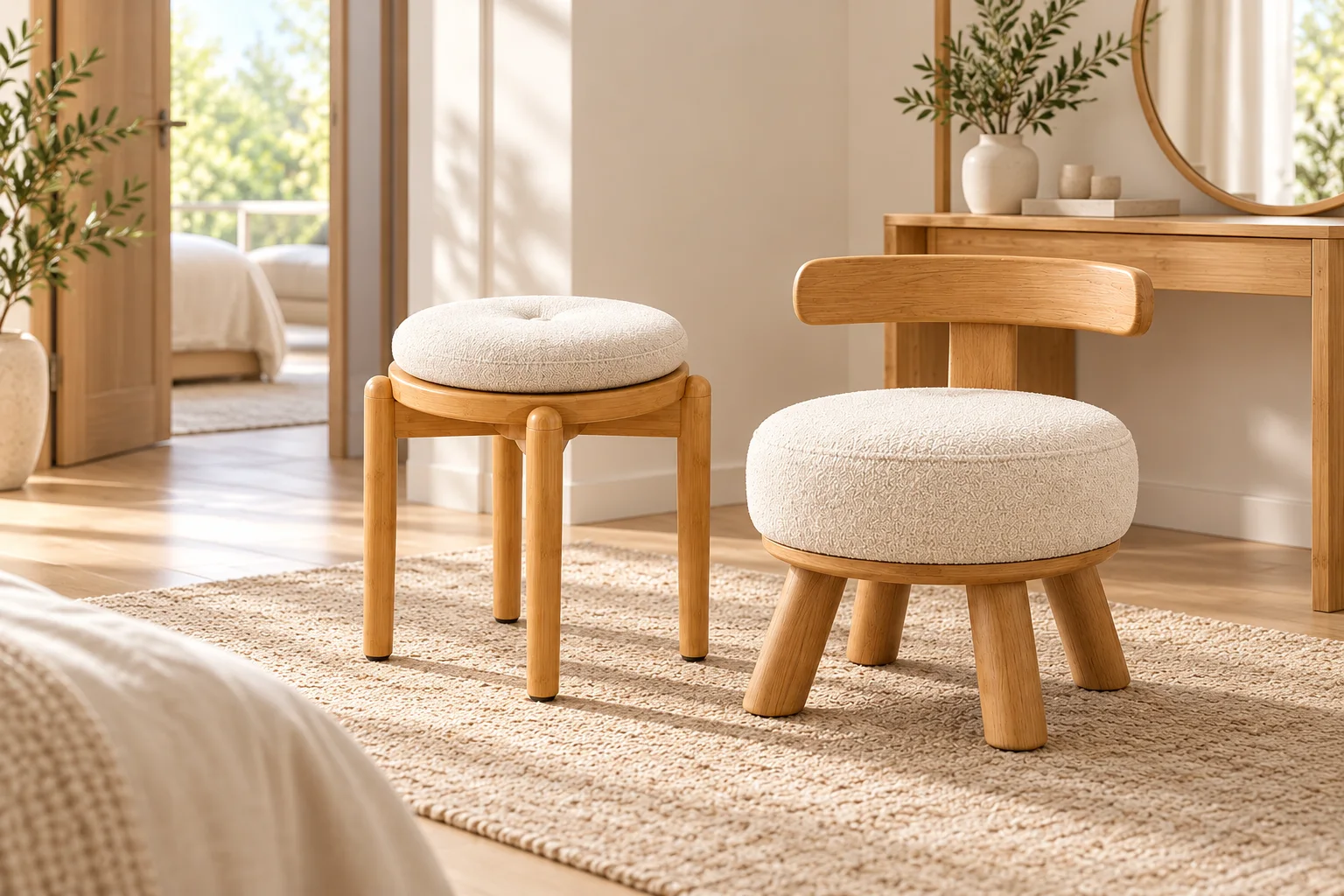
Choose the primary seating task first. That keeps a compact accent stool from becoming furniture that guests continually move out of the way.
Name the moment when someone will sit
A dressing-area seat is used with a table or mirror. A visitor seat faces another person. A stool near a bed may be used briefly while getting ready. Draw the body position for that particular task instead of placing an empty stool wherever the plan has a gap.
Ask what is already in the room. If the only missing task is somewhere to put luggage, specify suitable luggage furniture separately. An upholstered seat is not automatically approved as a luggage platform or a step.
Compare a low back with no back
The Upholstered Bamboo Round Stool has a padded circular seat and rounded bamboo-frame detailing. Its backless direction can be reviewed beside a vanity or within an occasional seating area.
The Accent Stool with Backrest adds a low curved engineered-bamboo back and a round upholstered cushion. That changes the seat's orientation and its relationship to a table. A low back is not evidence of full lounge-chair support, and neither reference establishes an adjustable office chair or a bar-height stool.
Evaluate the seat in its working position
| Seating task | Detail that matters | Useful trial |
|---|---|---|
| Dressing at a table | Seat height and approach to the actual tabletop | Sit, use the mirror and move away without moving the table |
| Brief visitor seating | Facing direction and space for legs | Place it opposite the occupied main seat |
| Getting ready near a bed | Reach and surrounding floor space | Reproduce the intended short seated action |
| Returning the seat after use | A defined position when unoccupied | Check that the stool can return without blocking a door or route |
Do not invent a universal seat-height rule from the product image. Table construction, cushion compression and the intended user affect the fit. Review the proposed assembled sample, not just nominal dimensions.
Decide whether it really needs to move
A stool marketed as compact may still be awkward to carry once its construction and upholstery are finalized. If staff or guests must move it frequently, review the handling point, weight and proposed floor protection on the actual sample.
Neither cited page promises nesting, stacking or a carry handle. Keep those requirements explicit if they matter. Likewise, a position under a vanity must be checked with the full frame and, for the low-back version, the backrest included.
Give the extra seat one dependable role
Confirm the primary task and the position before choosing upholstery color. Then review upholstery suitability, cushion construction, finish, stability and project-specific performance separately. Visual compatibility with a guestroom does not establish commercial compliance.
For a guestroom accent-seat discussion, send the room position, adjacent table or bed information and the expected seated task. Final dimensions, bamboo construction and upholstery follow the approved project specification; optional features should not be assumed from a room visualization.