
A cabinet wall can look modular without being made of independent, interchangeable boxes. One design may share side panels between bays. Another may use complete cabinets joined together. Both can produce a similar front view, but they create different ordering, assembly and alteration questions.
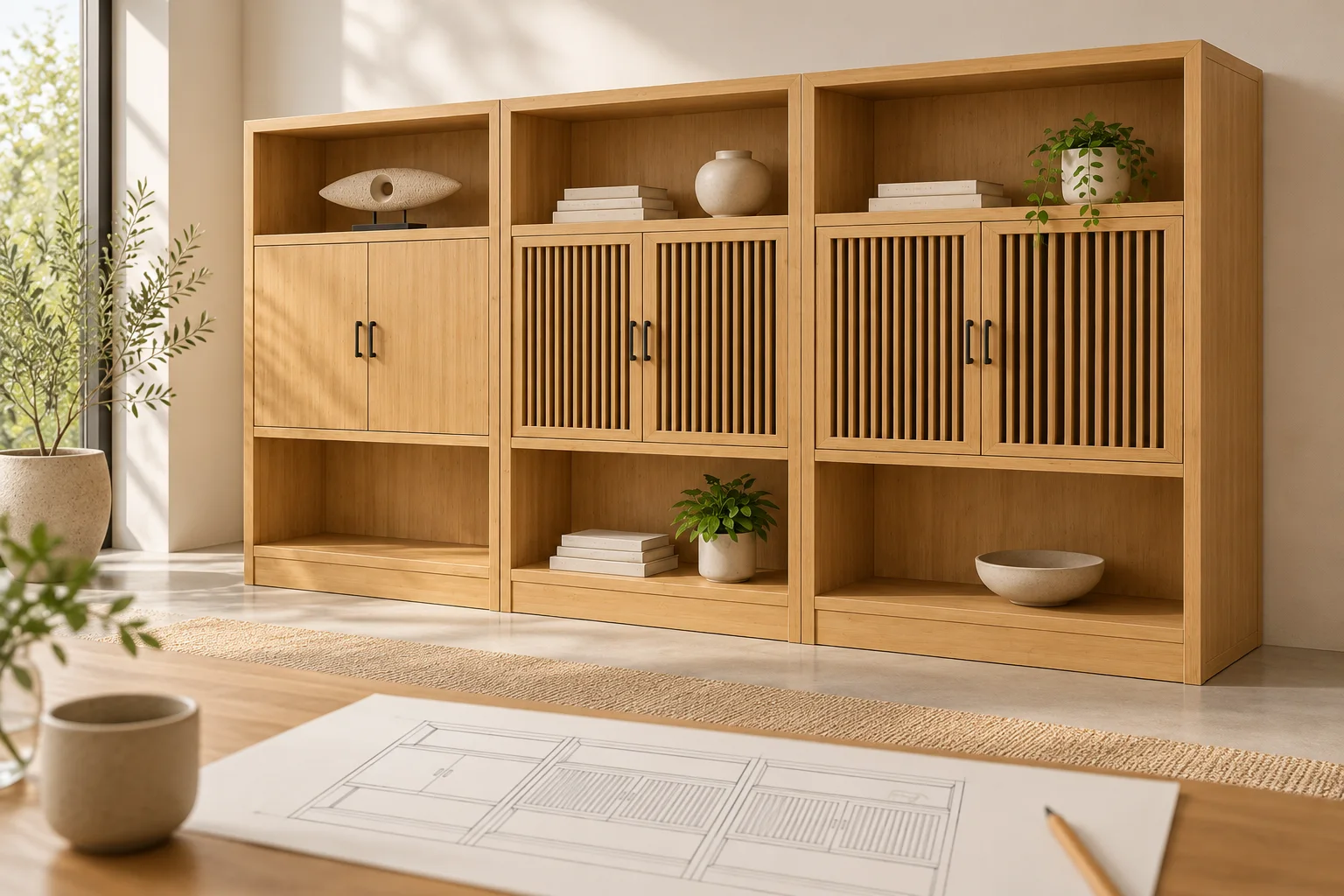
Before counting modules, agree what the supplier means by one unit.
Distinguish a bay from a supplied cabinet
The Modern Bamboo Slatted Storage Cabinet describes a three-bay reference composition with open shelving and concealed storage. Total length, bay count, door arrangement and internal layout can be reviewed for the project.
That scope establishes design flexibility. It does not establish a ready-stock modular system with universal connectors. Ask whether a bay is a visual division, an independent cabinet or a section of a shared structure.
Mark shared parts on the drawing
Identify side panels, tops, bases and back panels that belong to one cabinet or continue across several bays. If an open bay changes to a closed bay, ask which parts and connections must change with it.
This also affects the packing description. A separately packed section is not necessarily a freestanding cabinet, and a knock-down proposal does not mean any bay can later be removed without work on the neighboring sections.
Resolve the exposed ends
| Boundary | Decision to record | Why it affects the order |
|---|---|---|
| Between adjacent bays | Shared panel or two separate cabinet sides | Changes the build-up and assembled overall width |
| Outer end of the composition | Finished exposed side or a project-specific end treatment | The visible end may differ from an internal joint |
| Top or base across bays | Continuous part or separate pieces | Affects joints, packing and assembly sequence |
| A proposed later extension | Whether the existing end and connection can be altered | Determines whether expansion is feasible, not guaranteed |
Mark the ends that visitors can see. If the same design is ordered in two- and three-bay arrangements, compare their end treatments as well as their front elevations. Simply subtracting one bay from a rendering leaves those details unresolved.
Treat a later addition as a separate question
If future expansion matters, say so before approving the first version. Ask what drawings and connection details would be needed, which parts would have to be replaced and whether the original material and finish could be resampled.
Do not treat that discussion as a commitment to keep a module in stock or reproduce the exact finish years later. Future supply, compatibility and matching need their own confirmation. A project-configurable cabinet is not automatically an open-ended retail system.
Order a defined composition
Give each approved arrangement its own item reference. Attach the bay layout, shared-part drawing, finished ends and assembly scope. This lets a purchasing team distinguish a shorter composition from the same number of cartons or loosely described “modules.”
For a modular storage-cabinet discussion, provide the current composition and any genuine future-change requirement. Final bamboo materials, structure, fixing requirements and connections follow the approved drawings and sample; design flexibility alone does not establish safe standalone use or interchangeability.