
A concealed hook has two appearances: a quiet wall surface when closed and an active hanging point when open. Approving only the closed view leaves the useful half of the design untested.
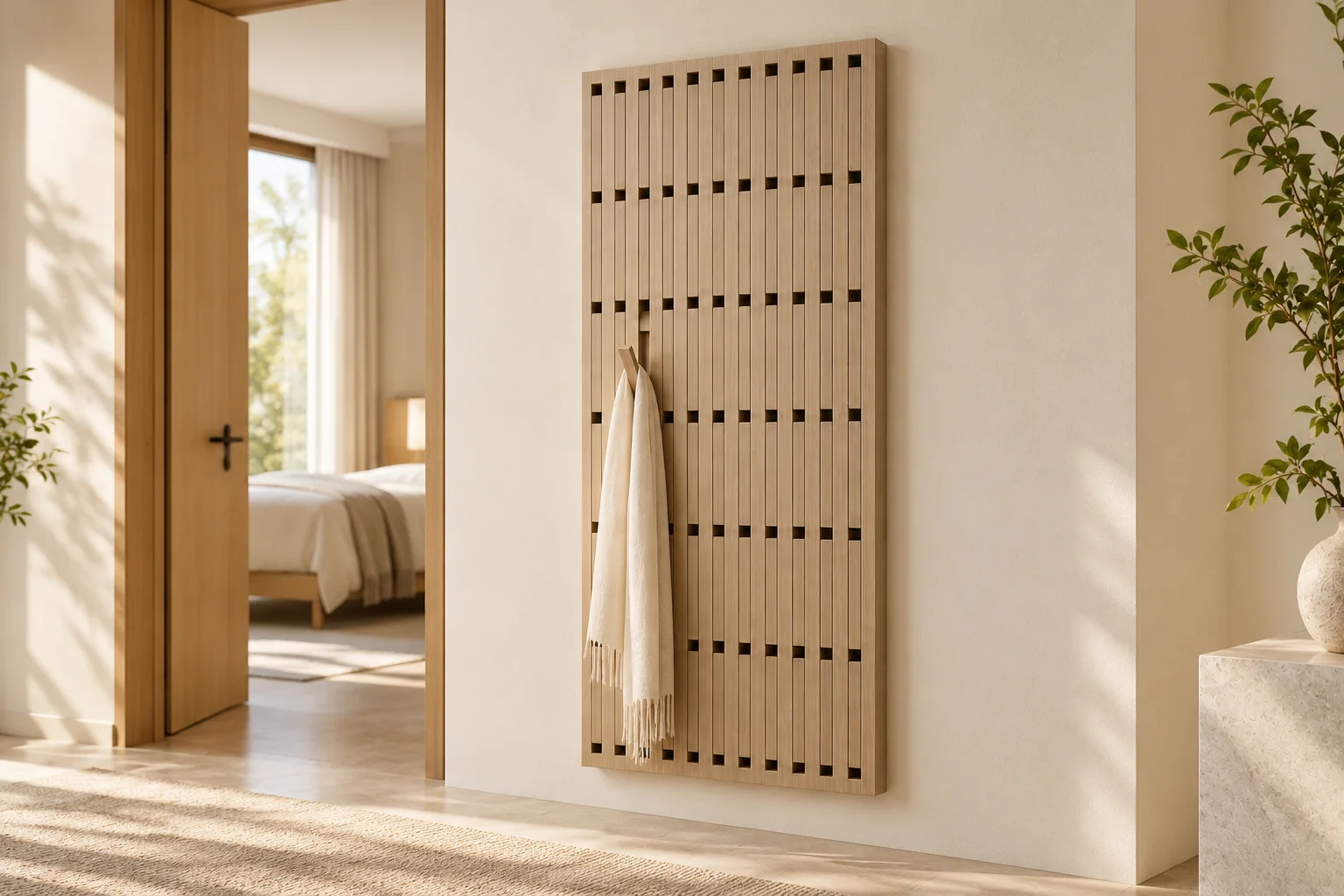
For a guestroom entry or dressing area, review the complete sequence: open the element, hang the intended article, remove it and return the element to its closed position. Each step can reveal a different requirement.
Use the intended article, not just a hook symbol
The Piano-Key Functional Bamboo Wall Panel presents individually operated flip-out hanging points within vertical bamboo elements. It is a design direction for project review, not a published universal hook capacity.
Define the intended articles by how they attach. A coat may hang from its loop or a separate hanger; a handbag has a strap with its own width and flexibility. These do not necessarily occupy the same point or hang at the same distance from the wall. Record the actual attachment method rather than treating every item as a small circle on the elevation.
Look at the hanging silhouette
A hook can be reachable while the garment below it overlaps a switch or brushes furniture. Show the hanging article's outline as well as the hook location. For several active elements, review whether adjacent coats or bags overlap and whether one article obstructs access to another.
Keep door swings and the room's required circulation visible on the plan. The closed panel's shallow appearance does not establish the projection of an open element plus its contents. The responsible project team must confirm placement and any applicable access requirements.
Check the operating sequence
| Stage | What to review | Decision to retain |
|---|---|---|
| Opening | How the selected element is reached and operated | Proposed grip, movement and permitted operation |
| Hanging | The actual loop, hanger or strap at the hanging point | Intended attachment and clear space around the article |
| Several hooks in use | Neighboring articles and access to each point | Spacing and permitted simultaneous use |
| Returning to closed | Removal of the article and closure of the element | Closing action, alignment and relevant instructions |
Keep operation separate from engineering approval
An operating sample can show motion and article fit. It does not establish permitted load, repeated-use performance, safe gaps or wall-fixing adequacy. Those require the appropriate design review and evidence for the final panel, mechanism and substrate.
Use only approved articles and review procedures when demonstrating the sample. Do not hang a heavy bag to discover a load limit. Ask what remains attached when the panel is serviced and whether moving elements are replaceable; neither feature should be assumed from the visual concept.
Write a functional brief alongside the wall elevation
Identify the active elements, article types, intended users, quantity and installation condition. Keep the agreed operational limits and instructions with the selected panel version. If the hook geometry changes, the closed façade and the hanging arrangement both need another review.
Discuss a concealed-hook wall-panel project with the hanging requirements and room layout. Final bamboo construction, mechanism, loading, fixing and maintenance scope must be confirmed separately from appearance approval.