
Vertical grooves give a cabinet a different surface from a flat door. The effect may be appealing, but a cloth moving across the front does not necessarily contact the recesses in the same way as the raised faces.
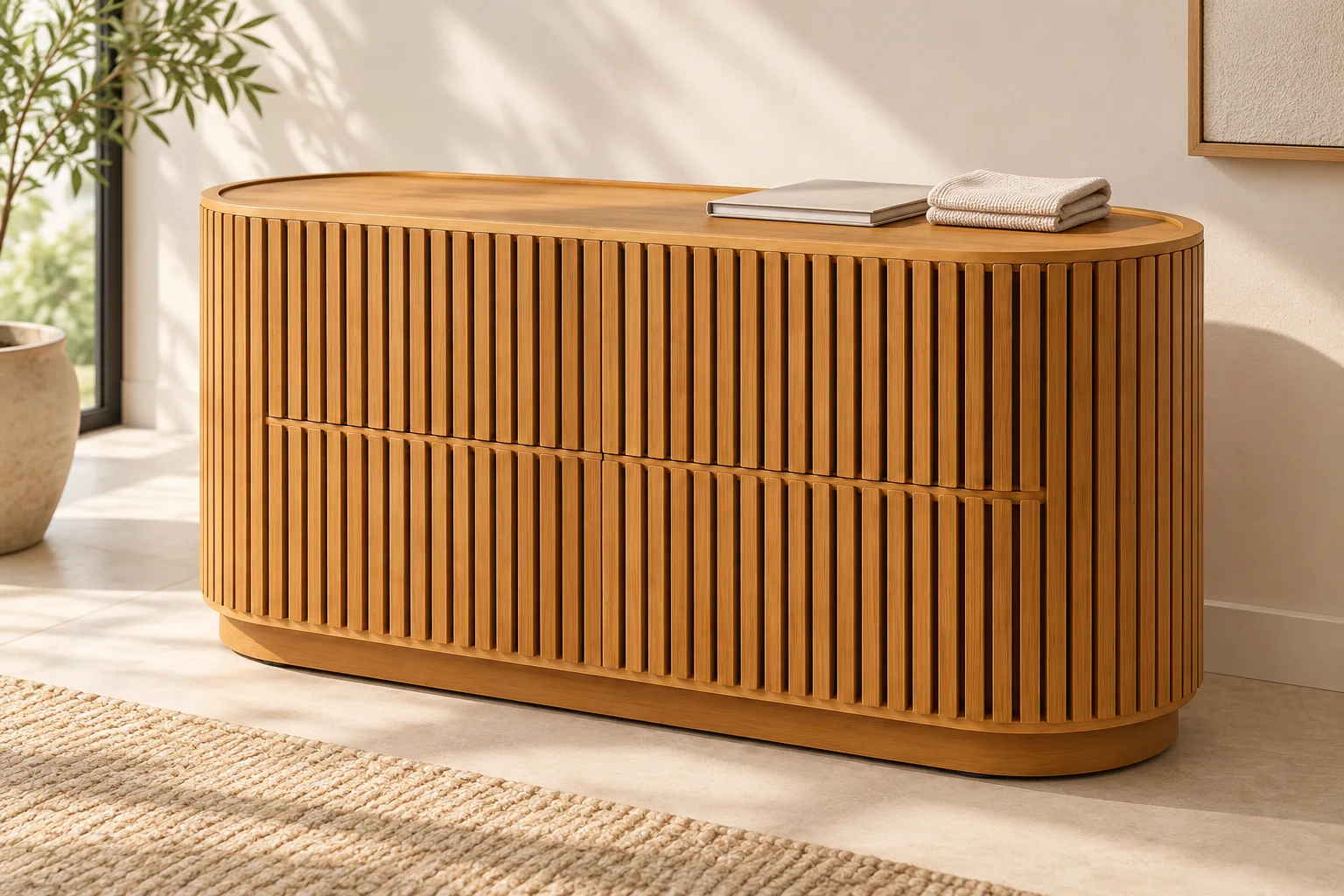
For hospitality or regularly maintained interiors, include the finished front in the care review. A color chip cannot show whether the operator can reach the places that need attention.
Distinguish the front from a flat finish sample
The Ribbed Bamboo Sideboard Cabinet presents a continuous ribbed exterior and rounded ends. The Modern Fluted Bamboo Storage Cabinet uses a vertically detailed front. Final profiles and finishes remain project decisions.
Ask the supplier what the proposed recesses and raised surfaces are made from and how they are finished. Do not infer a particular coating or water tolerance from the word “bamboo.” The profile sample should represent the actual proposed build and finish, including relevant edges.
Describe the operator's routine before selecting a tool
Provide the cleaning products, equipment and frequency the client intends to use. Request instructions for the finished assembly, not just a general material-care paragraph. If the routine has not been chosen, keep that decision open rather than approving a method nobody has reviewed.
This guide does not recommend a detergent, brush, steam treatment or solvent. A tool that reaches a groove may still damage its coating. A cleaning agent suitable for another cabinet is not automatically suitable for the selected finish and hardware.
Review the places that receive different contact
| Front detail | Practical care question | Evidence to retain |
|---|---|---|
| Recessed groove | Can the approved method reach the recess? | Representative profile and supplier instructions |
| Raised edge | Does the chosen contact method alter the finish? | Agreed sample-review method and result |
| Door break or pull area | How is ordinary hand contact dealt with? | Care scope for the operating area and fitting |
| Curved end or return | Does the same routine cover the changing profile? | Sample showing the relevant curved or end detail |
Evaluate a representative finished assembly
Where maintenance is a selection criterion, ask for a sample that includes the necessary groove, edge and opening detail. Let the supplier and operator agree a review method before applying products or equipment. Record what was used and what the sample represented.
Look at appearance before and after the agreed procedure, including the recesses rather than only the face. The observation is specific to that method and sample; it does not establish unlimited cleaning resistance or a guarantee about long-term use.
Make care part of the approved cabinet version
Keep the profile, finish reference and instructions together. A change in coating, rib depth or hardware can affect the method and should not inherit the earlier approval automatically. Identify who supplies the final care document and how any restrictions reach the furniture operator.
Discuss a fluted-cabinet project with the design reference and intended maintenance routine. Final material construction, finish and care claims need project-specific confirmation; visual texture alone establishes none of them.