
A restaurant clears some tables after breakfast, but the chairs still need somewhere to go. Asking for stackable seating sounds like a storage solution. It becomes a useful specification only when the supplier confirms which chair can be stacked, how it rests on the next chair and how the stack will be handled.
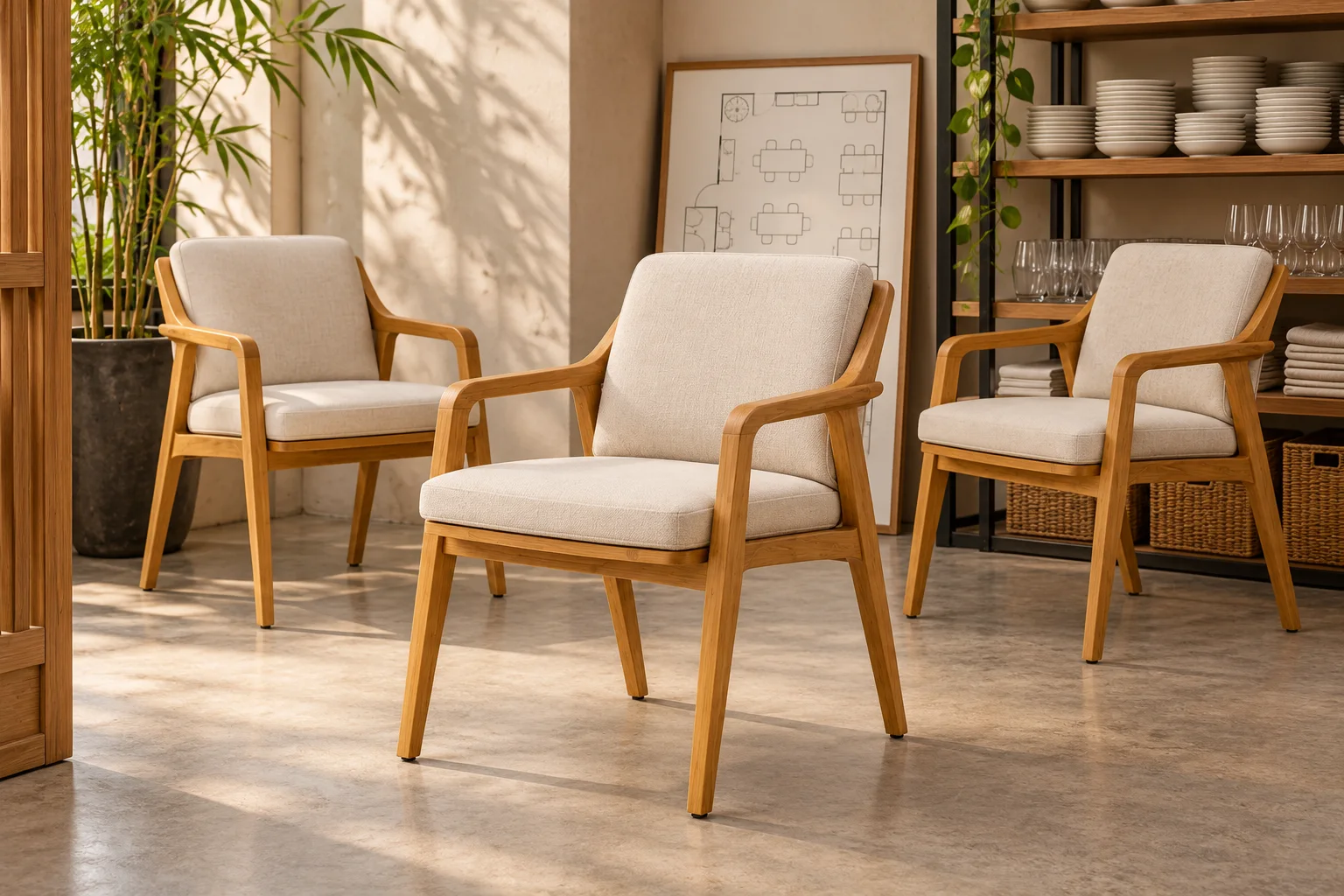
Begin with that confirmation, not with an estimate of how many chairs appear to fit together in a photograph. An upholstered seat or an open back does not establish a stacking design.
Separate a preferred silhouette from a stacking requirement
The Engineered Bamboo Arm Dining Chair offers integrated arms and upholstered seating. The Curved Bamboo Dining Chair has a layered open back and a project-reviewed seat construction. These are dining-chair references, not confirmed stacking models.
If either appearance is preferred, send the storage requirement with that reference and ask whether it can be met by the proposed construction. Record a negative answer as clearly as a positive one. A fixed, non-stacking chair may remain the right choice if there is another workable storage arrangement.
Also distinguish stacking from nesting chairs side by side or placing chairs on a table. They create different contact, handling and support conditions. Approval of one arrangement does not approve the others.
Ask where one chair rests on the next
For a proposed stacking version, request a drawing or representative sample showing the intended contact points. Identify whether the contact is between structural parts, protective fittings or another specified surface. Keep the upholstery, exposed frame and back rails visible in this review.
Do not add improvised pads or force two sample chairs together to discover a possible arrangement. The supplier needs to define the permitted position, any supplied protection and the appropriate handling instructions. Ask the responsible team what supporting assessment is required for the intended use.
Draw the stack in its storage location
Use the supplier's confirmed limits to show the complete stored arrangement. Record its floor outline, overall height, orientation and the space needed to remove one chair. Include the person retrieving it and any approved handling equipment.
| Decision | Buyer information | Confirmation required |
|---|---|---|
| Chair identity | Preferred item and upholstery version | Whether this exact version is designed to stack |
| Contact arrangement | Exposed faces and protection requirements | Permitted contact points and supplied fittings |
| Stored stack | Storage position and available space | Approved stack limits and complete outline |
| Handling | Who moves chairs and how often | Permitted method and any required equipment |
| Retrieval | Route from storage to the dining room | Access without rearranging unrelated furniture |
The table is a purchasing record, not a stacking instruction or a universal stack count. Do not multiply a chair's individual height to calculate the stored stack; the actual overlap must be established for the approved design.
Approve storage as well as seating
Where a sample trial is agreed, have the supplier and responsible operating team review the permitted arrangement and ordinary retrieval procedure. Keep appearance, seated use and storage approval as distinct decisions. A successful visual demonstration does not establish a load rating or other required performance evidence.
Use the sample approval record to retain the chair version, accepted arrangement and outstanding questions. For a restaurant seating enquiry, include the chair quantity, storage plan, frequency of relocation and preferred design. Confirmed supply scope should follow the reviewed version rather than the word stackable alone.