
Two inspectors can write down different widths for the same table without either having identified the reason. Before debating the number, check that they measured the same feature, under the same agreed conditions, against the same acceptance requirement.
Do not derive a tolerance from the catalogue size
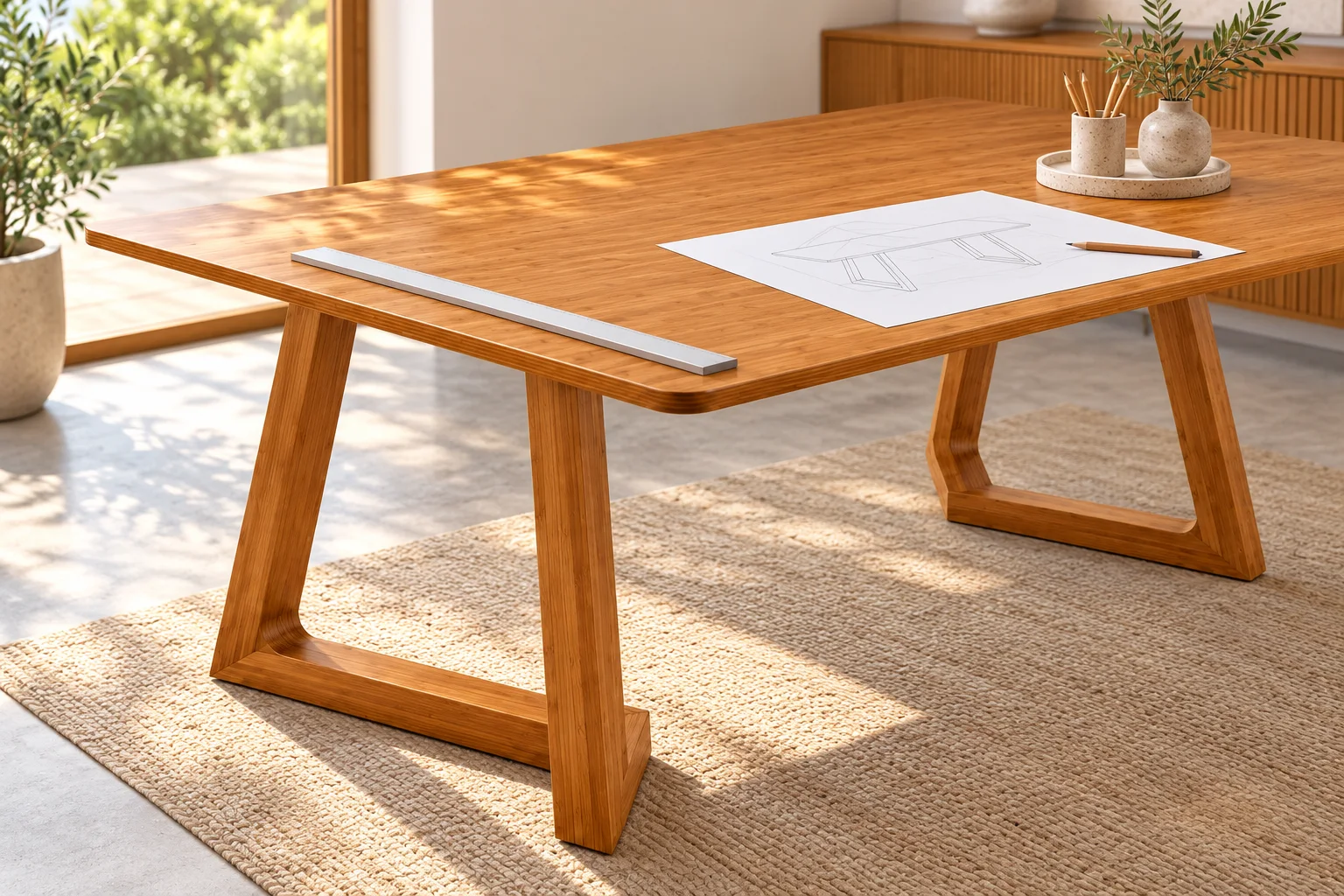
The trapezoid-base dining table is listed at 160 × 80 × 75 cm. Those nominal dimensions do not state a permitted manufacturing variation. They also do not say how an inspector should resolve a result close to an agreed limit. Ask for those decisions separately before production, especially where furniture must fit a restricted space.
Keep three kinds of information separate
NIST’s definition of measurement uncertainty concerns the range of quantity values associated with a measurement. It is not a ready-made furniture tolerance. The purchaser and supplier must agree acceptable product limits, while a competent inspection provider determines an appropriate measurement method and treatment of uncertainty.
| Field | What to record | What not to substitute |
|---|---|---|
| Dimension identity | Marked reference points, unit and drawing revision | An unlabelled overall-size number |
| Product requirement | Agreed nominal value and permitted limits | A tolerance guessed from catalogue rounding |
| Measurement record | Item identity, method, conditions and observed value | Only a photograph with no defined endpoints |
| Borderline result | Agreed review route and decision authority | Automatic acceptance because two readings differ |
This table deliberately gives no universal plus-or-minus value. Suitable limits depend on the feature, construction and intended use; they cannot be inferred from another model’s specification.
Review the disagreement before changing the requirement
If two readings fall on different sides of a limit, retain both original records. Check endpoints, assembly condition, instrument suitability and the inspection method. Then ask the responsible inspector to apply the agreed decision rule or arrange a controlled remeasurement. Do not average incompatible readings just to obtain a convenient pass.
A rounded edge, a soft upholstered surface and a clear opening between supports are different measurement tasks. The method needs to identify the relevant feature. A check of the outside width cannot prove the usable opening width.
Keep a concession separate from a passing result
Where the buyer considers accepting a documented deviation, route it through the authorised project decision-maker and record exactly which items and requirement it covers. Do not silently widen the specification for the rest of the order. A dimensional concession does not resolve separate safety or performance requirements.
Use the drawing approval guide to keep revisions aligned. Send the critical dimensions and intended fit so feasibility and acceptance requirements can be discussed before the order is released.