
A sewing class ends with half-finished work, not an empty room. If every project has to be piled on the cutting table, the next group cannot start. Plan sewing-classroom furniture around both the lesson and the changeover: where people cut, where machines operate, and where unfinished work waits intact.
Give each task its own requirements
New Mexico State University’s sewing-center guide discusses distinct work areas and storage around the user’s activities. Its general planning principle is useful; the height figures in that guide should not be treated as a universal specification for a room of different adults.
For machine work, identify the actual machine, extension table, pedal position, power connection and the manufacturer’s support requirements. For cutting, identify the largest pattern you regularly teach and the reach needed around it. Pressing needs its own suitable equipment and operating arrangements. Do not hide all three under one “craft table” line in the quotation.
| Task | What the furniture brief records | What remains after class |
|---|---|---|
| Pattern preparation | Largest paper pattern, mat and fabric layout | Pattern pieces kept with the project |
| Machine work | Machine model, working height and support review | Machine stays or is put away by the agreed method |
| Hand finishing | Seated workspace and small-tool containers | Tools accounted for separately |
| Project storage | Tray outside size, contents and identification | One complete project can be retrieved without unpacking another |
Use a dining-table dimension as a comparison, not an approval
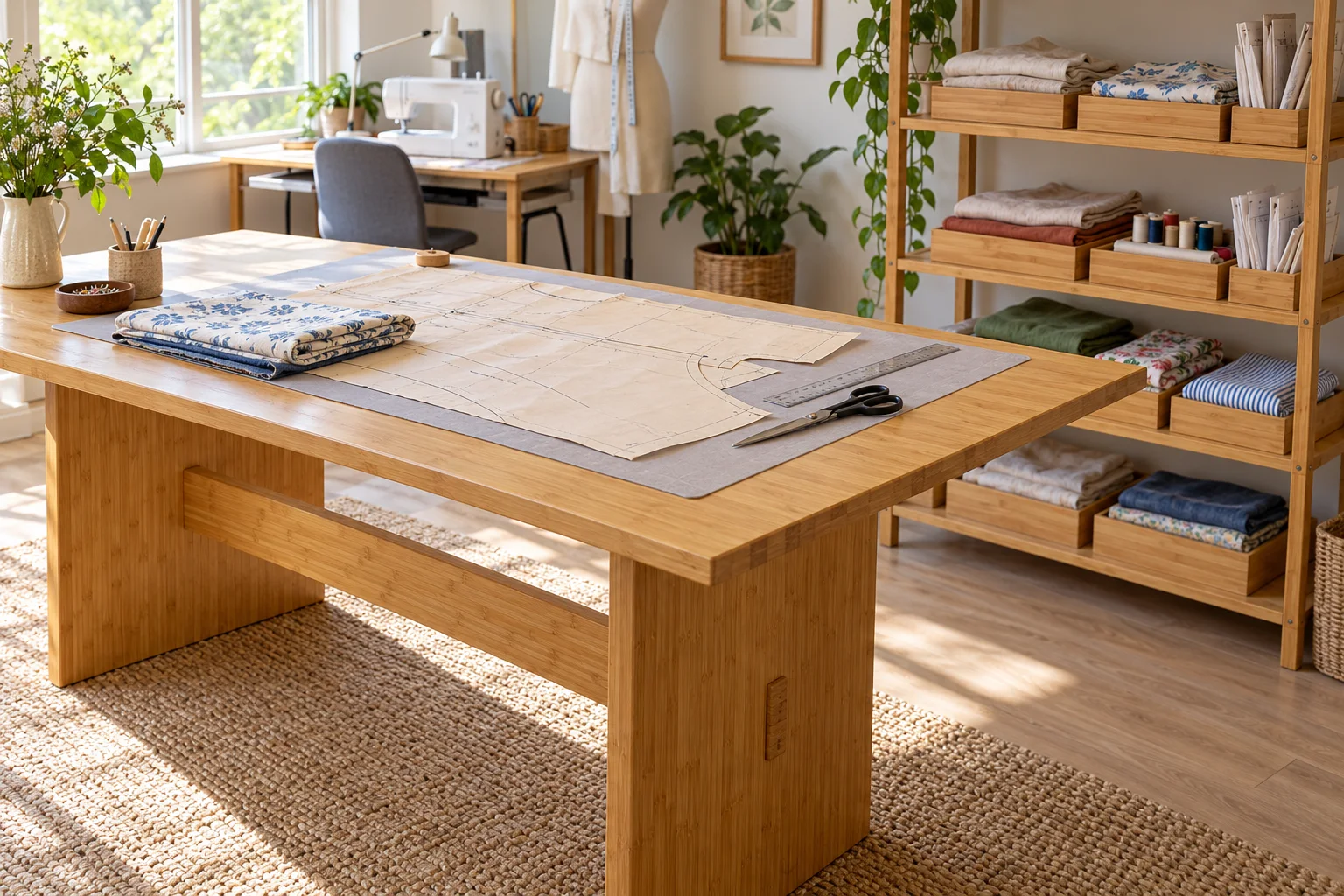
The Rectangular Bamboo Trestle Dining Table is listed at 140 × 70 × 75 cm. That gives you a real outline to compare with paper-pattern preparation or other dry tabletop tasks. It does not establish a suitable standing cutting height, resistance to machine vibration or compatibility with a sewing-machine insert.
Lay the largest relevant pattern inside that outline. Include the section of fabric that hangs or needs support, and try reaching the far side without assuming every edge will remain accessible. Check the panel legs and stretcher against intended seats and pedals. If the task needs a different height or construction, put that requirement to review instead of improvising risers or cutting the furniture.
Choose the project container before the shelf
For the bamboo open shelving direction, specify the tray’s outside dimensions including handles, not just the folded fabric. Allow for removing it while neighboring trays remain in place. Confirm shelf clearances, loading and any required restraint with the project team.
The two-drawer bamboo sideboard offers a separate closed-storage direction for shared supplies. A drawer shown in a picture does not prove it locks or fits sharp tools safely. Define who controls tools and choose an appropriate storage solution for that routine.
Rehearse one class leaving and another arriving
Use a sample unfinished project and walk through clearing a seat, collecting tools, transferring the work and restoring the shared surface. Record the points where two people need the same shelf opening. A room that holds all its furniture may still lack somewhere to handle a project during changeover.
Send the lesson types, machine details, largest pattern, project-tray measurements, class overlap and room plan when you request a sewing-studio furniture review. Include quantities for the general furniture separately from specialist machine and pressing stations. The open-shelving measurement guide can help turn the tray list into clear storage dimensions.