
One cabinet between two hotel beds can look economical. The important question is whether it gives two guests usable bedside places. A shared telephone, two phones, glasses and a reading book are not one person’s belongings doubled: they need clear ownership and access from opposite sides.
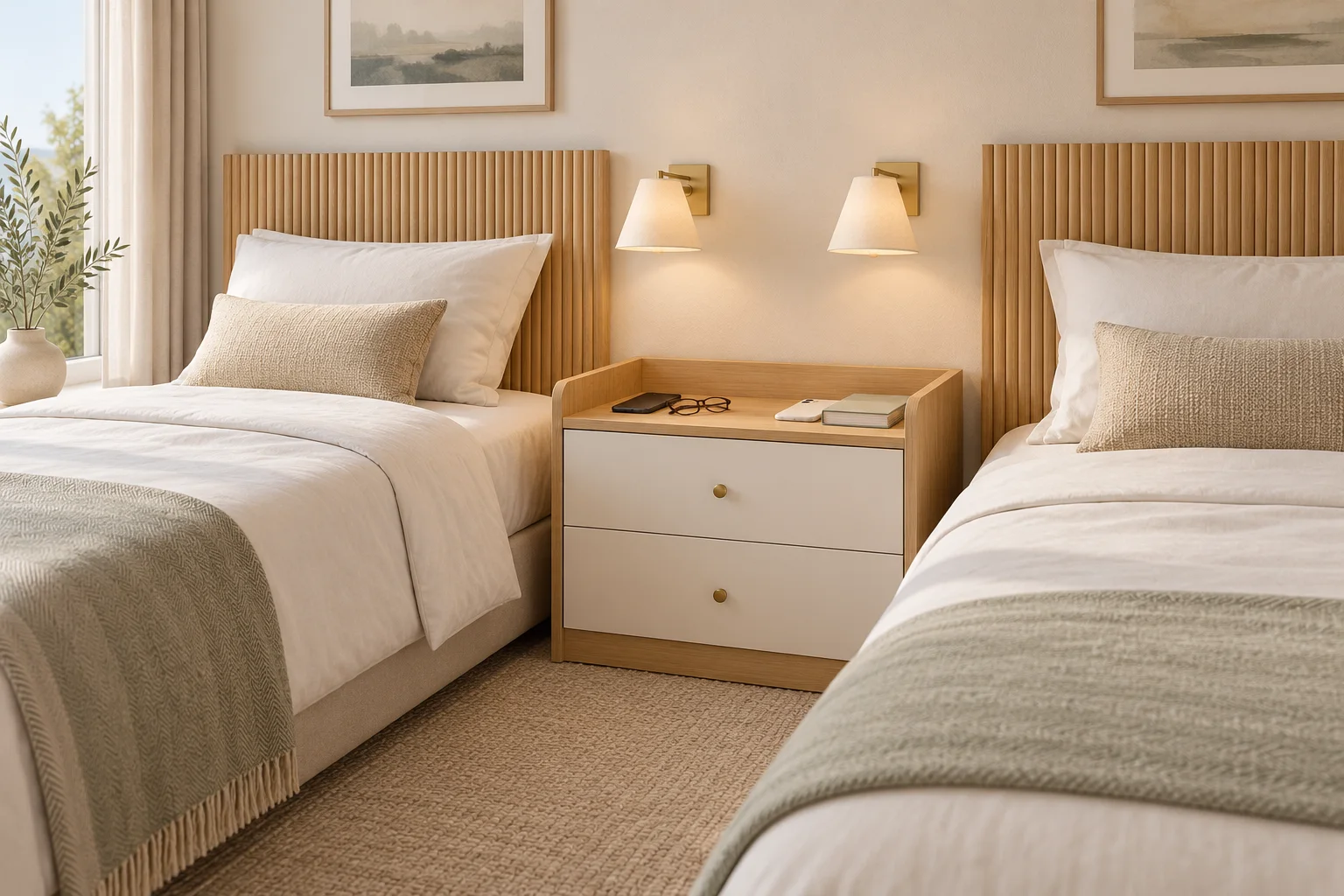
Draw two personal places and one shared place
Make two small lists, one for each guest. Then list hotel-supplied items separately. Put a paper outline for every item on a proposed top. Show which guest reaches for each one and whether that action crosses the other person’s belongings. A shared lamp base should not consume the only useful surface for either guest.
NCHMCT’s room-division textbook describes twin rooms and a Hollywood-twin arrangement with a bedside table between beds. Those room definitions do not specify the right cabinet for your project. Use them to describe the room clearly, then assess the actual two-person use.
| Item group | Intended access | Question for the furniture brief |
|---|---|---|
| Guest A belongings | From the first bed | Is there a distinct landing and storage place? |
| Guest B belongings | From the second bed | Is access equally practical without crossing A’s things? |
| Shared hotel items | Both guests or staff | Do controls and hotel supplies occupy a separate agreed position? |
| Drawer contents | Named guest or shared use | Does drawer access remain clear with both beds occupied? |
| Alternative room layout | Approved positions only | What happens to the central cabinet when beds move? |
Do not confuse two drawers with two independent users
The Engineered Bamboo Two-Drawer Nightstand has a raised-edge top and two closed drawers. It can illustrate a closed-storage option, but two vertically stacked drawers do not automatically give two guests equally convenient access. Try both occupied bed positions, including who stands to open each drawer.
The Modern Engineered Bamboo Nightstand combines an open compartment and a lower drawer. Its storage types are different, not necessarily interchangeable personal allocations. If private individual storage is important, request that explicitly rather than assuming an open shelf and a drawer provide the same function.
Review every intended bed configuration
If the operator changes between twin and another approved bed layout, draw both complete arrangements. Where does the central cabinet go? Does it become an outer-side table, need a separate parking place, or remain in position? Check that the proposed furniture count works in both drawings without borrowing a cabinet from another room.
The bamboo platform bed is a design reference whose mattress and frame details require confirmation. It is not evidence that two units can be joined, safely moved in a particular way or used with a shared headboard. Any conversion mechanism belongs in a separately approved bed specification.
Order bedside access, not just a cabinet count
A central cabinet may work if each guest has a useful surface and the room arrangement supports it. Separate pieces may suit independent storage or changing layouts. Neither choice is universally better. Keep lighting, charging and building services under their responsible project scope; do not infer electrical fittings from an illustration.
Use the bedside fit guide for mattress height and clearances. Send your ownership map, both room layouts where applicable, item dimensions and quantity schedule when requesting twin-room furniture. Ask for confirmation of the chosen configuration before repeating it across all rooms.