
A bamboo cart carrying covered plates has a different specification question from a bare display surface holding unwrapped pastries. Before asking for a “food-safe finish,” describe where food actually touches and how the item will be cleaned.
Draw the contact boundary in the service sequence
Start with receiving, loading, transport, display and clearing. Identify the plate, tray or container that touches the food at each stage. Record spills and foreseeable contact separately; calling an item a serving cart does not resolve its use.
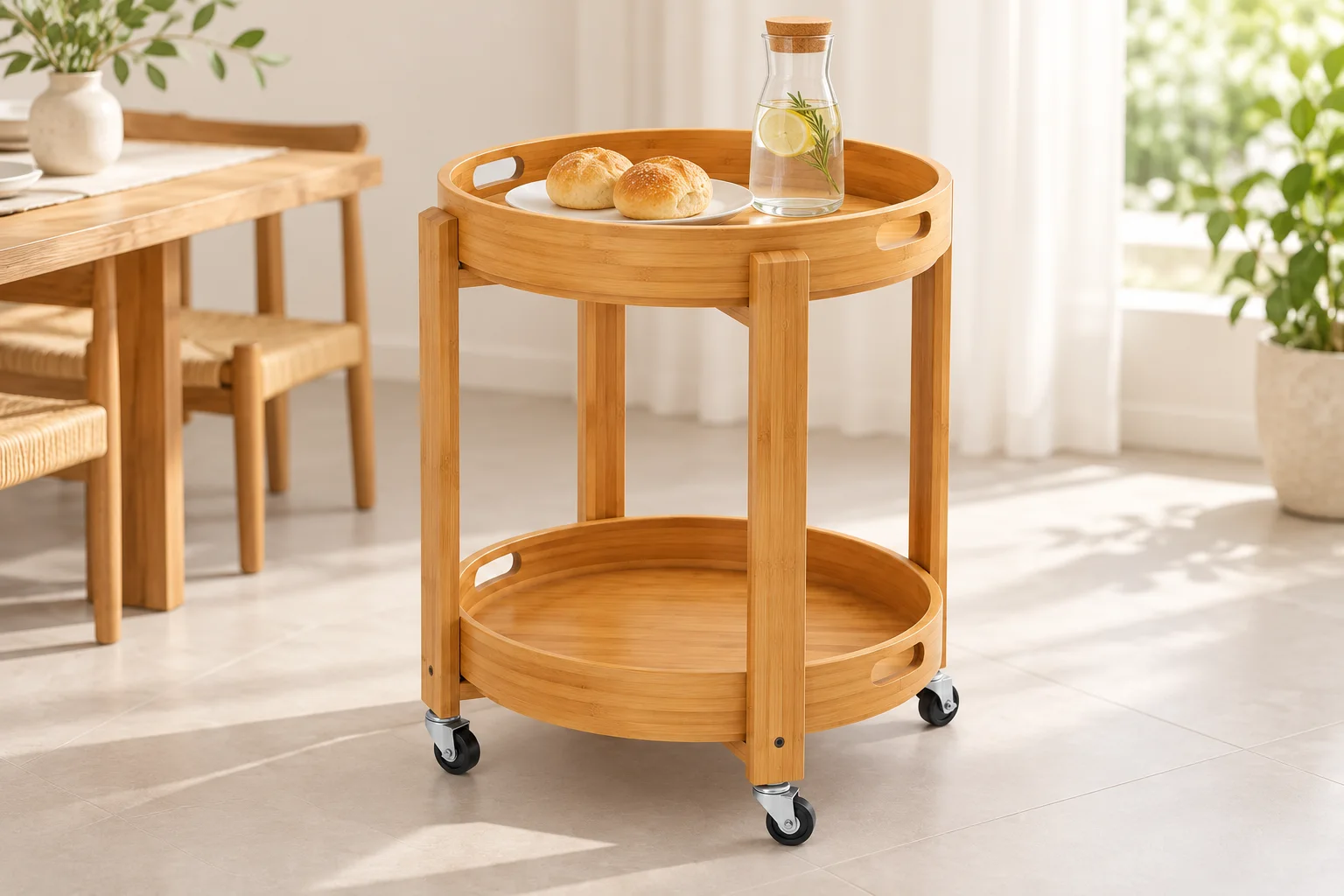
The round two-tier bamboo cart shows raised tray edges and wheels. Those features help discuss handling and appearance. They do not demonstrate that its finish is approved for direct contact with food, for cutting, or for commercial wash equipment.
| Review item | Evidence to record | Do not infer |
|---|---|---|
| Service task | Food in a plate, covered container or direct contact | A product called a cart is food-contact approved |
| Surface evidence | Material, finish and intended-use documentation | A smooth-looking coating proves suitability |
| Cleaning | Separate instructions for furniture and tableware | A dishwasher-safe tray makes the cart washable |
| Operational change | New review for loose-food display | The original plated-service approval covers every use |
Ask for evidence that matches the actual contact
FDA’s 2026 Food Code is a model for retail and food-service safety. Its equipment provisions distinguish food-contact and nonfood-contact surfaces. The applicable local requirements and the proposed materials need review for the real operation; a general furniture finish description is not that review.
Tell the supplier whether the furniture is only a carrier or is intended to become part of a direct-contact arrangement. Ask for the available material and finish information. If evidence is missing, keep direct contact unapproved rather than adding an unsupported claim to the purchase order.
Review the tableware and cleaning method together
A separate serving tray is useful only if it is suitable for its intended food use and fits the handling process. Check whether staff can place and remove it without trapping residue around edges, and who cleans each part. Do not assume an ornamental liner or any transparent sheet is an approved food-contact barrier.
Give the supplier the planned cleaning products, frequency and wet-contact conditions. Confirm permitted care for the furniture separately from cleaning or sanitizing the tableware. Do not transfer a dishwasher instruction for a removable plate to the bamboo cart beneath it.
Use a short release note for the operational team
The approved service arrangement should be understandable after the purchasing team leaves: what goes directly on the furniture, which containers are required, what cleaning instructions apply and which use remains excluded. Keep this with the selected model and finish record.
If a venue later changes from carrying plated meals to displaying loose food, reopen the review. The earlier order described a different contact condition. No food-contact certification is claimed for a catalog product in this guide; the purpose is to obtain a sufficiently specific enquiry.
Send a simple service sequence, planned containers and care requirements with your bamboo serving furniture enquiry. That gives the supplier a clearer question than “food-safe furniture.”