
Furniture that arrives flat-packed is not automatically designed for repeated moves. If a showroom or project programme expects later disassembly, make the next build part of procurement acceptance instead of discovering the limits after the first installation.
State the future move scenario
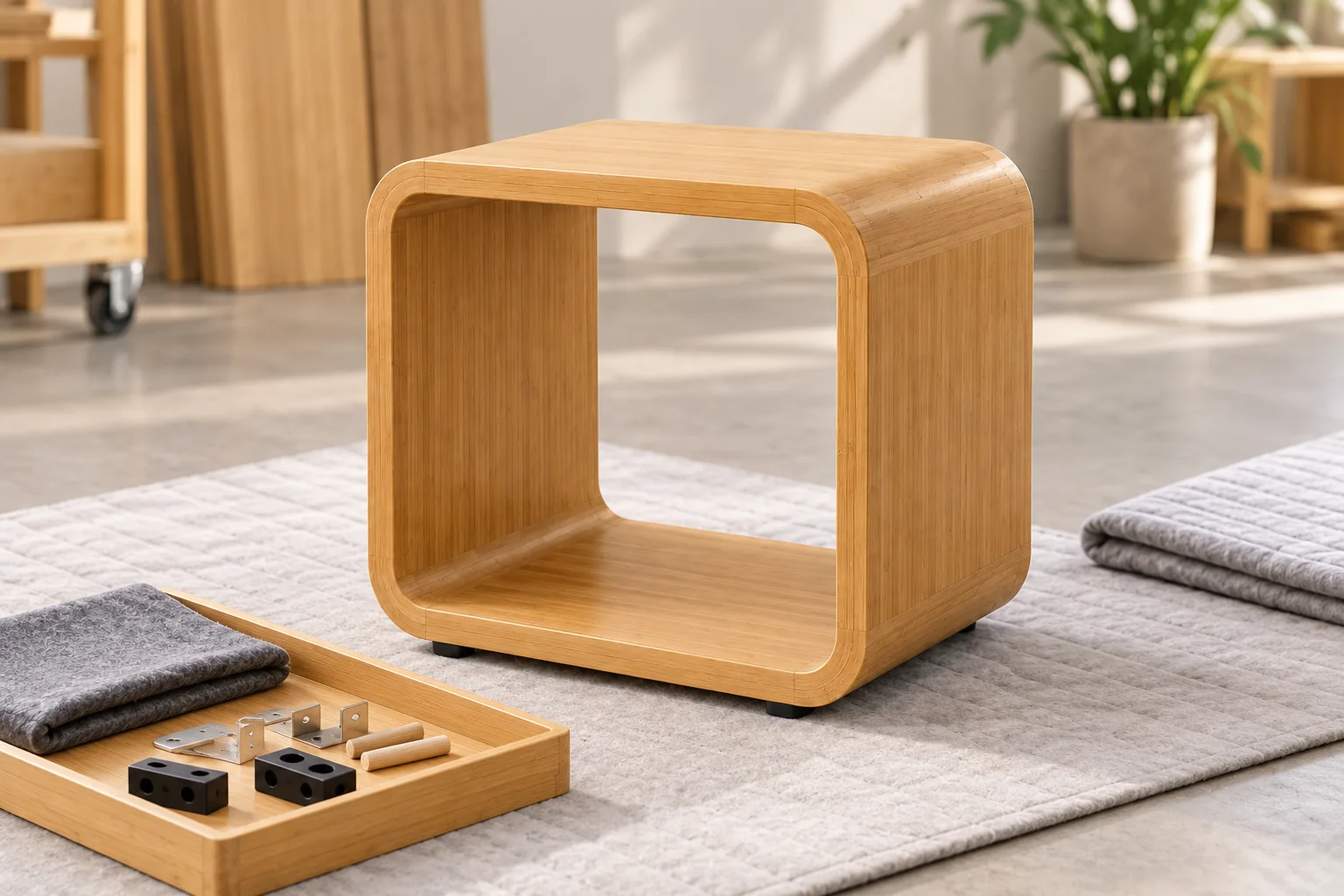
The rounded bamboo side table has an open core and curved external corners. Its visible seams invite questions about how panels join, but the product page leaves the joint method to engineering review. Neither the image nor the packaging route proves that the body can be taken apart.
Describe why disassembly is required, how often it is expected and who will perform it. Distinguish removing an approved accessory from separating the load-bearing body. Ask the supplier to identify joints that must remain intact.
Classify every connection by reuse status
Request a connection map with three categories: approved to reopen and reuse, reopen with specified replacement parts, or do not separate. Include any access holes hidden by adjacent pieces, and the protection required for detached surfaces.
Lamello describes Clamex P-14 as a detachable connector that can be reopened. That is an example of a designed feature, not evidence that this table uses it. The actual bamboo construction and connector combination need their own approval.
Write the second-build acceptance sequence
Agree a representative sample and number of teardown/rebuild cycles with the supplier before testing. Record the first assembled condition, have the appointed team disassemble only approved joints, pack and handle the pieces as planned, then rebuild using the authorised procedure. Record replacement parts used at each cycle.
| Stage | Record | Decision gate |
|---|---|---|
| Before teardown | Baseline condition and approved joint map | Only authorised joints opened |
| During separation | Tools, damaged parts and consumables | Reuse or replacement identified |
| Rebuild | Procedure, component fit and joint closure | No unapproved workaround |
| After rebuild | Supplier assessment against agreed criteria | Accepted cycles and limitations recorded |
Compare the rebuilt unit with its baseline
Have the supplier assess joint closure, surface damage, component fit and the required furniture performance after rebuilding. Set the project’s acceptance criteria in advance. A successful second build is evidence for that sample and sequence, not a promise of unlimited cycles.
Keep the results with packing-form decisions and assembly instructions. If repeated separation cannot be supported, decide early whether to move the item assembled, change the design or choose another furniture direction.
Send a decision-ready inquiry
Send the furniture reference, expected move pattern and available assembly team through our project inquiry. Ask whether repeat disassembly is supported and request a priced sample test with explicit reuse limits.