
Yoga studio prop storage should be planned from the kit used in each class, not just the number of people in the room. Twelve students might need twenty-four blocks in one session and a different combination of bolsters and blankets in another. A shelf that holds plenty of objects can still leave the last student without a complete set.
Build the kit list with the instructor
Start with the actual timetable and the instructor’s prop list. Yoga Source’s amenities page gives a useful real-world example of different classes calling for different props. It does not provide a furniture capacity formula. Write your own list for each class, including instructor equipment, agreed spares and any props that are not available for use.
For a hypothetical twelve-person class using two blocks per person, the student requirement is twenty-four blocks before any separately agreed reserve. Record bolsters, blankets and straps in their own rows rather than combining everything into “twelve sets.” This makes a missing component visible and prevents one large basket from being mistaken for a complete class allocation.
Count the stock that has to be stored at the same time
If two rooms share props, establish whether their classes overlap and when the equipment is available for reuse. Do not count the same physical bolster for two simultaneous sessions. If sessions are sequential, the operator must decide the preparation and care interval; the furniture plan should not assume an instant return to service.
| Record | What to enter | Furniture consequence |
|---|---|---|
| Class kit | Each prop type and quantity per participant | Count components separately |
| Simultaneous demand | Rooms and classes using the same stock | Allocate the stock actually required together |
| Stored form | Folded blanket, uncompressed bolster, block or basket | Measure the actual storage arrangement |
| Available stock | Usable items separate from unavailable items | Keep the complete-kit count honest |
Keep any reserve explicit. Decide whether it covers an instructor, a damaged item or a change in the class format. An unnamed percentage added to every item can consume shelf space without solving the real shortage. This is a stock-planning exercise, not a recommendation about class size or exercise practice.
Try removing the last complete kit
Use the actual props in their intended stored form. A bolster is not an empty rectangle: its fabric, end shape and handle can affect how it is taken out. Do not rely on compressing soft items to achieve a capacity figure unless that storage method is acceptable to their supplier. Measure baskets with straps or small accessories inside.
Arrange the proposed stock and remove one complete kit at a time. Pay particular attention to the final kit: does retrieving its blanket require pulling out an unrelated stack, or does its strap disappear behind larger items? Compare grouping every component by type with using removable kit containers. The better choice depends on how the instructor distributes equipment, not on a photograph of a tidy shelf.
Keep ordinary shelving within an agreed role
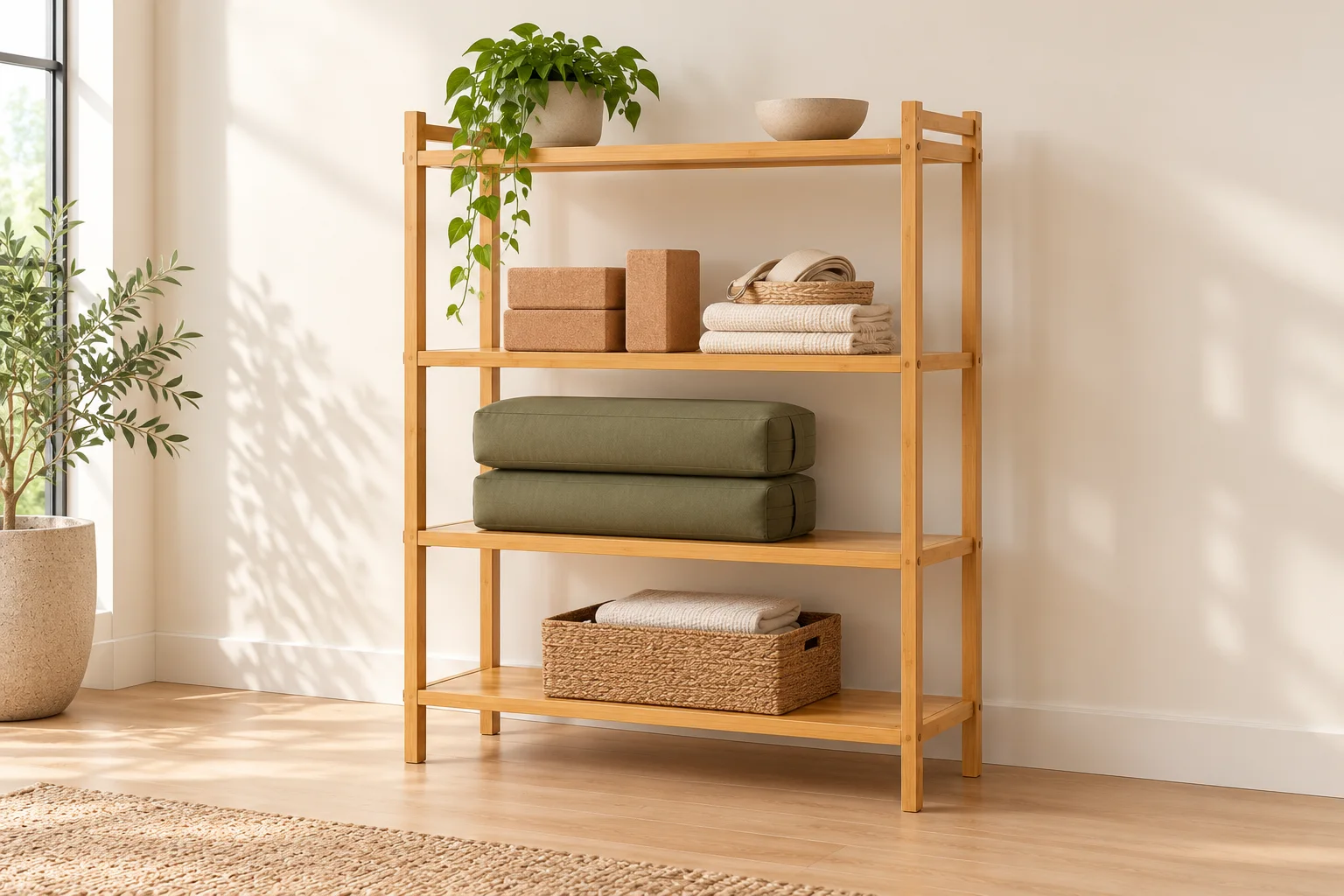
The Contemporary Bamboo Open Shelving Unit is a design reference with shelf spacing, dimensions and loading reviewed per project. It is not exercise apparatus. Do not use an ordinary shelf as a climbing, stretching or body-support device, or assume the same proposal suits heavy weights, heated wet areas or every cleaning product.
Use the shelf-clearance guide for the detailed opening measurements. For a yoga prop-storage enquiry, send the timetable, kit list, peak simultaneous stock, prop samples or measured dimensions, weights, storage method and dry-area care requirements. Discuss the final furniture development scope after those decisions are recorded.