
Moving a sideboard away from a wall can reveal a surface that nobody reviewed. The room rendering may show the attractive door side, while a guest approaching from the corridor sees the back.
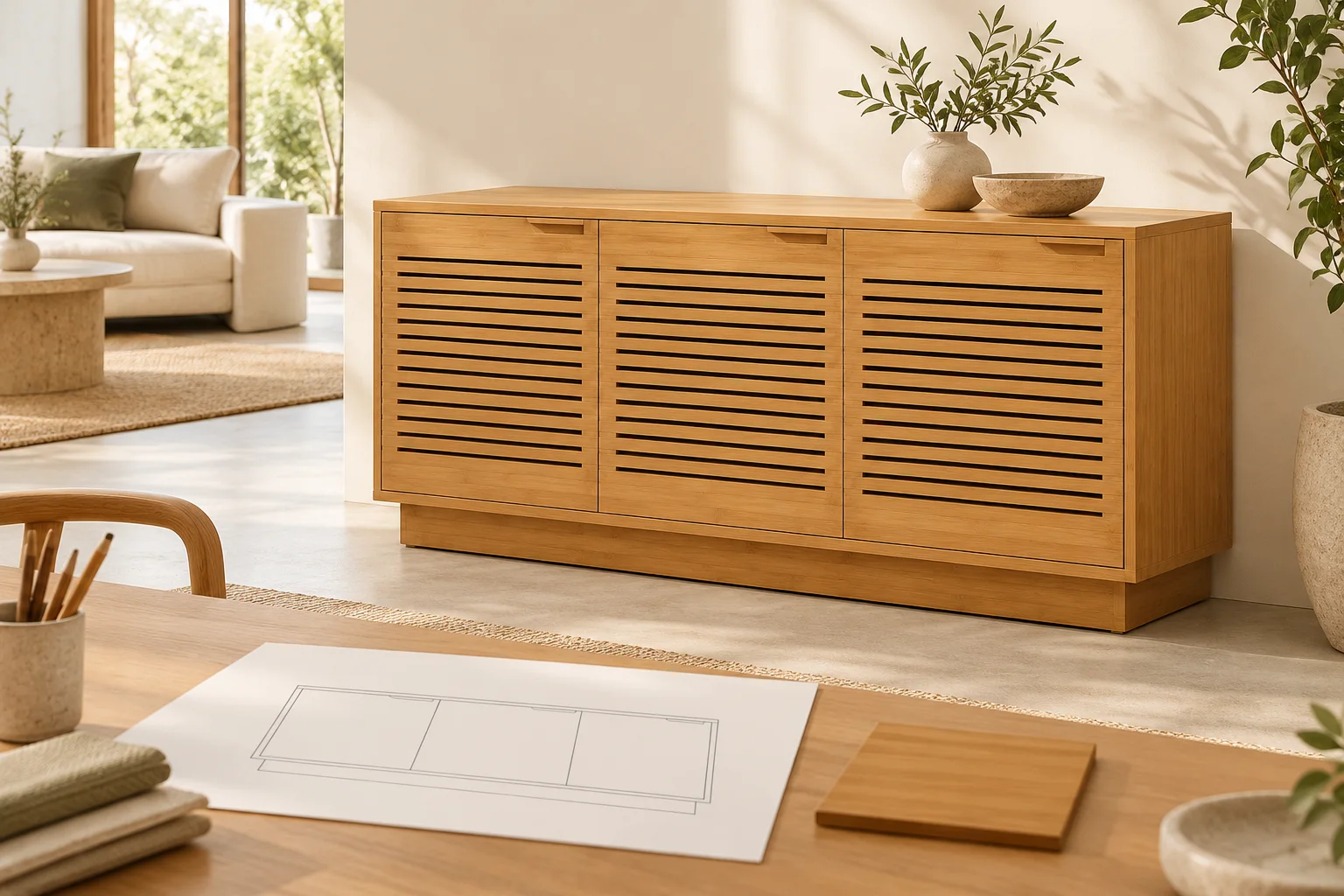
Before using a cabinet beside an open seating area, mark which rear surfaces will be visible. A finished-back requirement belongs in the order, not in a request to tidy up an already delivered item.
Draw the rear view from the actual approach
Mark standing and seated views on the room plan. Include an oblique approach, not only a direct view behind the cabinet. Name the rear face, exposed ends and the base area separately.
The Slatted Sideboard and Fluted Storage Cabinet are references for customizable casegoods. Their front treatments do not establish that the rear repeats the doors, uses the same construction or is approved as a display face.
Separate appearance from the rear panel's job
Ask which rear parts belong to the structural construction, which provide closure, and which allow service access in the proposed design. The answer should come from the actual drawings. Do not remove or decorate a back panel on the assumption that it is only cosmetic.
A flush appearance may conflict with a proposed access cover, exposed connector or installation requirement. Resolve that detail with the responsible supplier before choosing a finish. A cabinet with an attractive back is not necessarily reversible: doors, connections and required fixing can still depend on one orientation.
Put rear approval in its own view
| Rear feature | Decision to record |
|---|---|
| Main rear face | Material identity, surface finish and visible joins |
| Exposed end and base | Where the finish changes and which supports remain visible |
| Hardware or cover | Accepted visibility, access route and any proposed concealment |
| Service opening | Exact location and the equipment or maintenance task it serves |
| Placement | Approved orientation, support and fixing requirements |
Review the rear alongside the front, rather than asking for an unspecified same finish everywhere. Matching color does not establish matching grain direction or panel construction. The visible-face grain guide helps record those separate relationships.
Close the question before placing the cabinet in a render
Ask for a labeled rear elevation and, where relevant, a representative finished sample or documented view of the proposed construction. Confirm what it represents and what is still unresolved. Concept imagery does not demonstrate a manufactured rear detail.
Keep installation, stability, loading and any required restraints in the technical review. Finished-back appearance does not make a cabinet an approved freestanding divider. Send the cabinet placement and rear-view brief with the selected design reference, quantity and destination so the complete version can be reviewed.