
There is room for a suitcase beside the wardrobe. That does not yet show whether a guest can open it, reach both halves and pack again without moving it onto the bed.
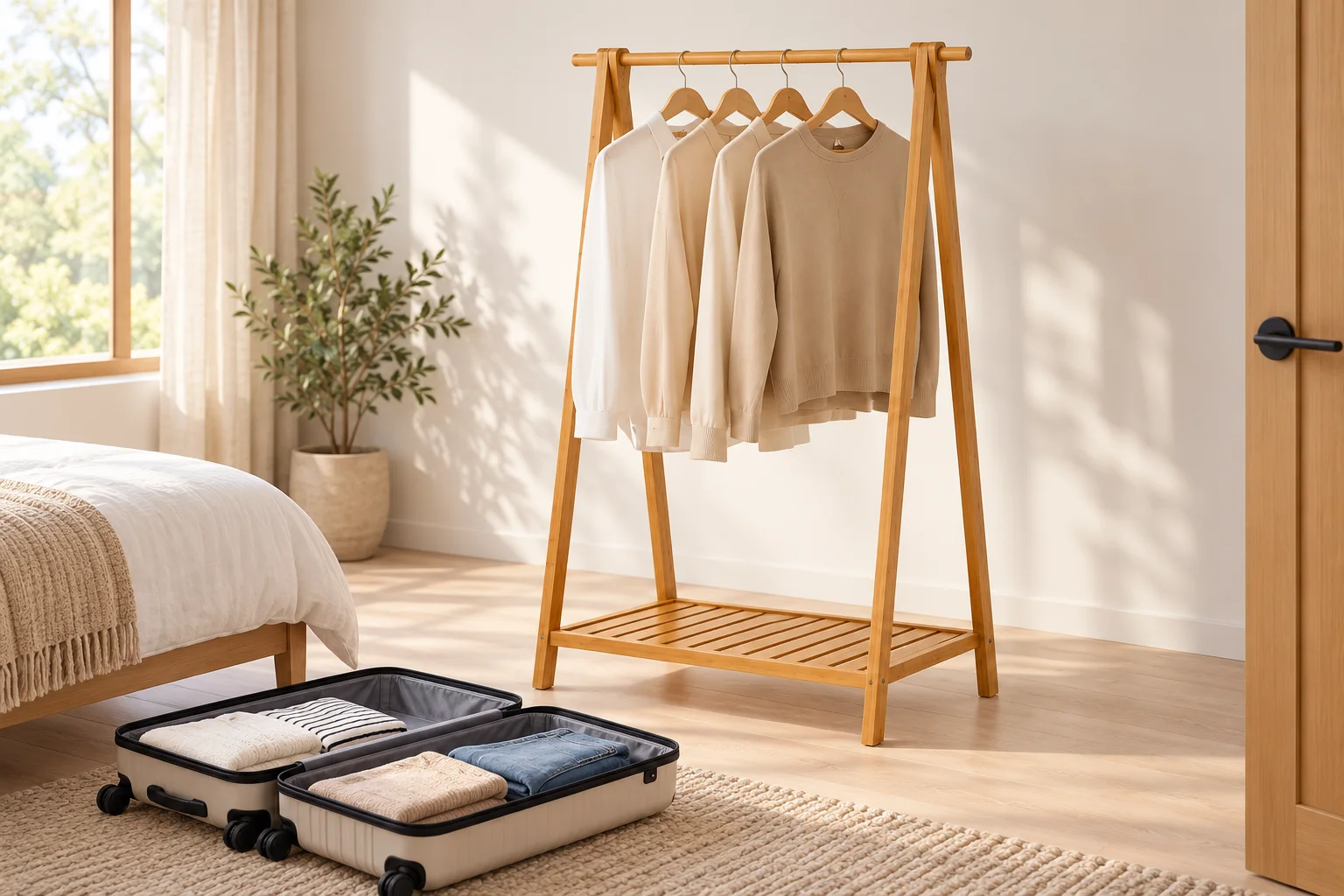
Separate luggage storage from luggage use. The closed case determines one outline; the opened case, projecting lid and guest's approach determine another. A piece of furniture considered for support needs its own confirmation as well.
Identify where the case goes at each stage
Show arrival, unpacking, closed storage and repacking on the room plan. These activities need not happen in the same position. Decide whether the operation expects luggage to remain on the floor, on a specified support or in another agreed arrangement.
The Open Wardrobe Rack has a hanging rail and a lower slatted shelf, with shelf layout and load requirements reviewed per project. That lower shelf is not automatic confirmation that it supports a full open suitcase.
Likewise, an Upholstered Round Stool is a seating reference. Its presence in a guestroom does not approve it as a luggage support. Give any proposed additional use to the responsible supplier for assessment rather than transferring the seating role silently.
Draw the complete opened case
Use representative luggage from the intended guest profile or a clearly identified planning example. Include the case body, opened lid, wheels, handles and any protruding parts. Mark which portions need support and which extend beyond it.
Record the opening method. A case with two opened halves may occupy the space differently from a case with one raised lid. Avoid treating a familiar suitcase size label as a complete drawing of the working arrangement.
If the required luggage profile is not yet known, retain that question. Do not turn one convenient sample into a universal promise for every guest's luggage.
Check the guest and the surrounding furniture
Place the opened outline beside the bed, wardrobe and room door. Show where the guest stands while retrieving contents and where the closed case waits afterwards. Include drawers or doors that may be used during the same routine.
| Stage | Outline to review | Decision to confirm |
|---|---|---|
| Arrival | Closed luggage and room approach | Where the guest can first place the case |
| Unpacking | Opened case and projecting parts | Intended support and access to contents |
| Closed storage | Stored case beside other items | Which room functions remain available |
| Repacking | Opened case and guest position | Whether the agreed arrangement still works |
Where furniture is proposed as a support, ask for confirmation of the complete use, expected loading and surface-care requirements. A dimensional fit alone does not establish structural suitability or resistance to suitcase wheels and fittings.
Keep the luggage role explicit in the room brief
For an agreed mock-up, use the nominated case arrangement and ordinary permitted handling. Record any substituted luggage or temporary support. The observation applies to that setup; it is not a capacity certification.
The open wardrobe guide helps allocate hanging and shelf storage. This luggage review adds the separate working outline of an opened case.
For a guestroom furniture enquiry, send the room plan, luggage-use sequence and proposed support role. Confirm whether the selected furniture can meet that role before calling a spare shelf or seat a luggage solution.