
The customer has narrowed the choice to three frames. A companion wants to compare them, the optician brings another tray, and the mirror occupies the remaining clear corner. This is the moment to test an optical-shop consultation table. Its job is to support a comparison, not just fill the space between display walls.
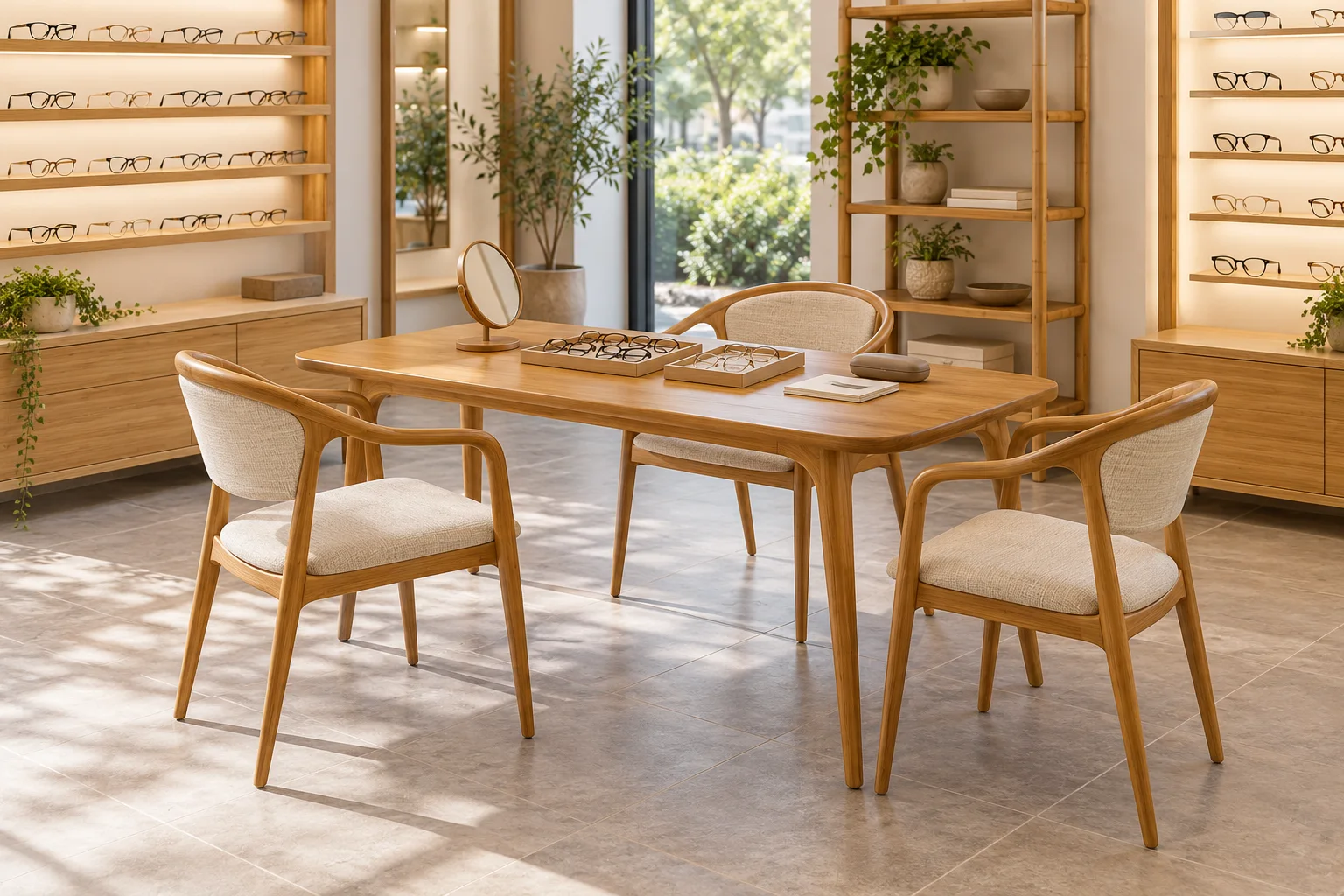
Draw the selection appointment before choosing the table
List the things that stay on the surface throughout the appointment: candidate-frame trays, a mirror, the customer’s own glasses and case, and whatever order notes staff actually use. Then add items that arrive later. Give the customer’s own eyewear a distinct place so it is not mixed with stock being returned to display.
OUYEE’s published optical-store design separates frame displays, a seated consultation area and professional service spaces. That is an external design example, not our project. For the loose furniture, take the next step: lay out the complete comparison on a trial surface using your actual trays and mirror.
| Position | What stays there | What to test |
|---|---|---|
| Customer | Own glasses and current selection | Can the mirror be used without moving the tray? |
| Companion | A separate seat | Can both people see the candidate frames? |
| Staff | Incoming and rejected-frame trays | Can stock change without reaching across personal items? |
| Reset | Returned stock awaiting the store’s handling routine | Where does it wait before going back to display? |
Compare the actual usable footprint
The Nordic Bamboo Restaurant Table has published 140 × 80, 160 × 80, 180 × 80 and 200 × 90 cm top-size options, all 75 cm high. These are dining-table dimensions, not an optical dispensing specification. Mark a shortlisted outline and place the real accessories inside it, allowing for its rounded corners.
A mirror that is easy for one person to use may block the companion’s view. Try its base and tilt range from each seat. If two appointments could overlap, do not assume one longer table is enough: check whether trays and conversations remain separate, and whether the store wants that arrangement at all.
Include the chair and the way people approach
The upholstered bamboo arm dining chair offers one furniture direction. Check arm clearance and how close each person can sit. Use the table-and-chair fit guide for the paired measurements. Do not derive a seat count or accessibility claim from the illustration.
Keep fitting instruments, frame heaters, adjustment tools and clinical examination equipment in their separately reviewed scope. A table that works for choosing frames is not automatically appropriate for professional measurement or heated equipment. Ask the practice team which tasks belong at this table before requesting furniture.
Specify the reset space with the purchase
A bamboo open shelving unit can be a direction for cases or identified trays, subject to clear openings and loading. It is not secure storage unless an appropriate solution has been specified. Keep any customer records in the practice’s chosen controlled storage.
To discuss furniture for your optical shop, send one photo of the complete trial arrangement, tray and mirror dimensions, staff and companion positions, room plan and quantities. State which professional tasks are excluded. That gives the furniture review a defined job instead of a vague request for an “optical desk”.