
A server station can be fully stocked at opening and still run out halfway through service. Making the cabinet larger is only one possible response. First decide what it must hold between replenishment trips, who refills it and whether staff can keep using it while that happens.
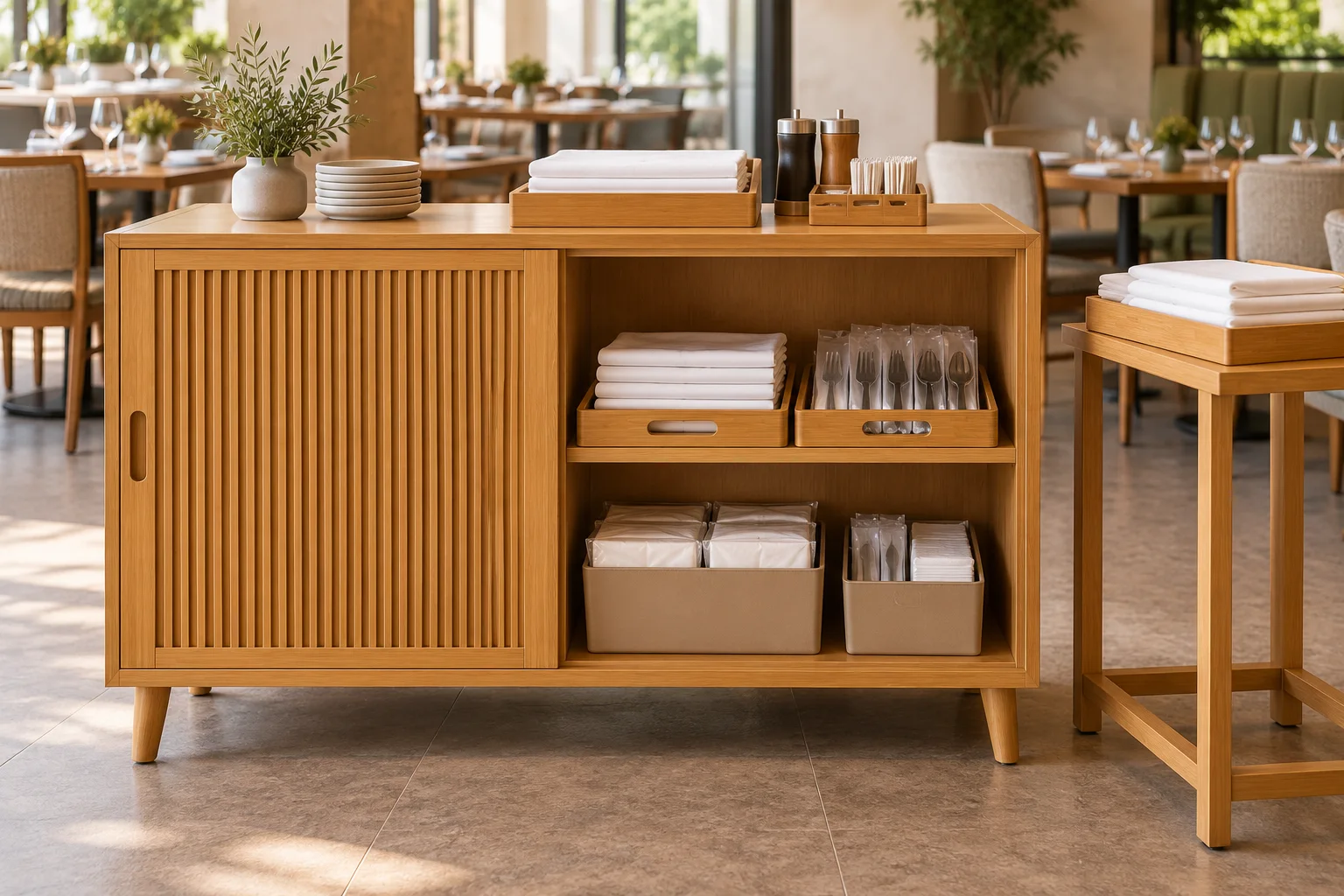
Count the interval, not the entire day
List supplies by how they are used: napkins issued per setting, service tools reused under the restaurant’s procedure, and spare items brought out only occasionally. Ask the operator for observed consumption during the busiest interval between planned refills. If there is no operating history, mark the estimate as a trial assumption and review it after service.
Uttarakhand Open University’s service foundation text describes the sideboard as storage for supplies used to serve a group of tables. The worksheet here adds a purchasing question: which of those supplies genuinely need to be in this cabinet now, and which belong in reserve storage?
| Supply | Operator records | Furniture decision |
|---|---|---|
| Frequently issued item | Consumption between refills and agreed reserve | Useful container size and accessible location |
| Occasional spare | How often staff actually request it | Local storage or a separate reserve location |
| Refill container | Outside dimensions and loaded handling method | Can it be exchanged without emptying the whole shelf? |
| Used-item return | Collection route and responsible person | Separate return provision, not a clean-stock compartment |
Turn the stock list into containers
Try the actual folded linen, protected cutlery packs or other approved supplies in their intended containers. Measure the filled container rather than an empty basket. Keep handling space above it and check whether someone can remove it without first moving the neighbouring stock. Loading limits need confirmation for the selected shelf and cabinet.
For an illustrative stock calculation, suppose the operator expects 24 napkins to be issued before the next refill and chooses six extra for its own buffer. The trial container must hold 30 in the actual folded form. These numbers are an example of the method, not a recommended stock ratio or a prediction of demand.
Try serving while someone replenishes
The Ribbed Bamboo Sideboard Cabinet uses concealed doors and adjustable shelves. The sliding-door bamboo sideboard offers a different opening arrangement. Compare them using one person taking an item while another replaces a container; the width of the cabinet alone does not tell you whether both tasks work.
Check where the incoming container rests and where the emptied one goes. If a door blocks the staff position, consider a different layout or refill sequence. Do not assume sliding access exposes every compartment at once, and do not infer a commercial duty rating from either catalogue description.
Keep clean stock separate from the return route
Used dishes, soiled linen and waste need the restaurant’s own suitable handling arrangement. A clean-storage sideboard should not quietly become the dirty-return station when the room gets busy. Food-contact surfaces, sinks, appliances and specialist sanitation requirements require their own specification and review.
Use the sideboard contents guide for detailed opening and object measurements. For a restaurant service-cabinet enquiry, send the refill worksheet, container sizes, cabinet location, staff approaches, quantities and care requirements. Request a cabinet proposal around that operation rather than a photograph of an attractive but unexplained station.