
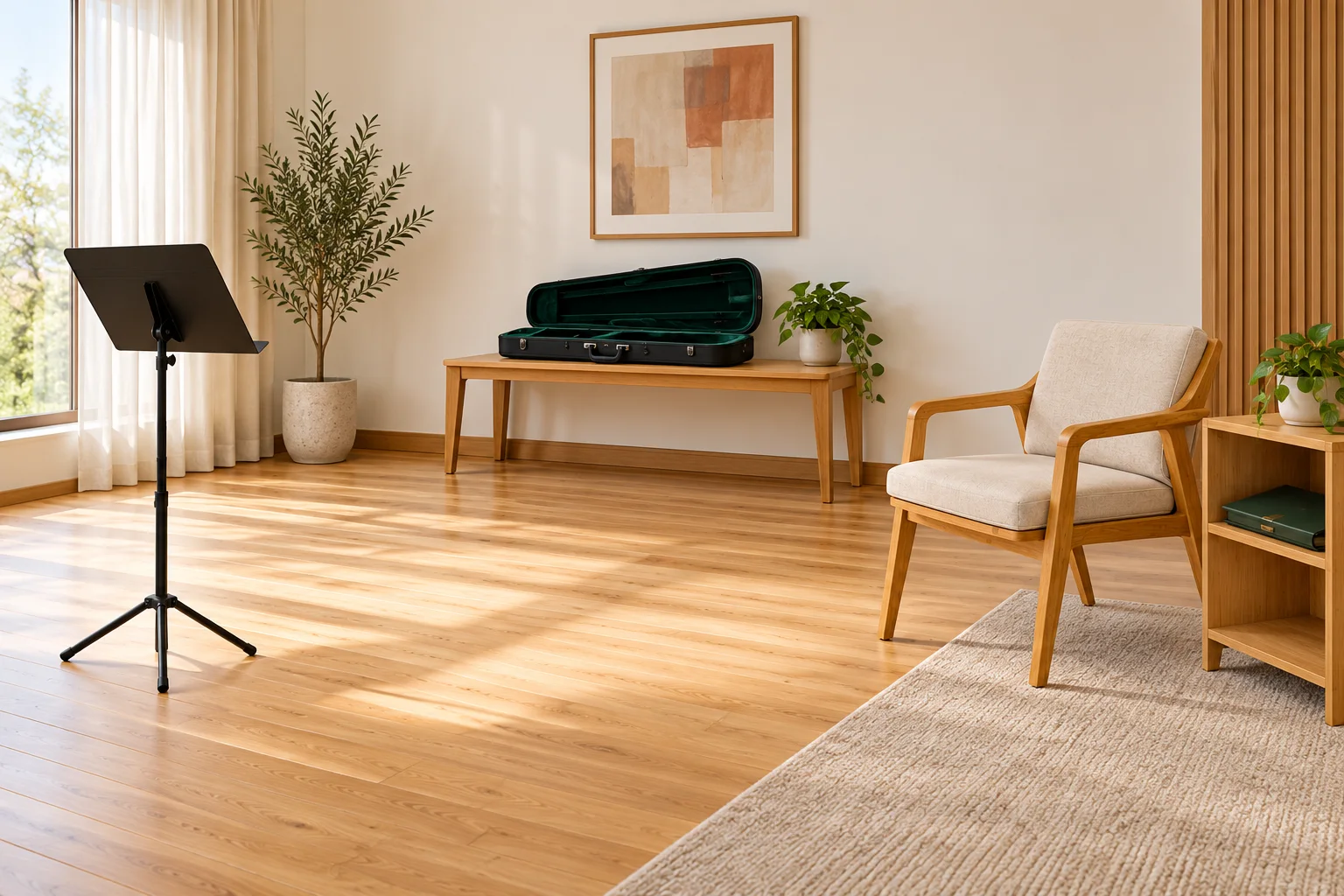
The empty teaching room fits a chair, a shelf and a music stand. Once a violin case opens and a parent sits down, the playing space may become much smaller. Furnish a one-to-one music studio around the lesson sequence, with observer furniture clearly separated from the musician’s working area.
Let the teacher define the playing space first
Maple and Spruce Violin/Viola Studio’s setup advice distinguishes the student’s playing position from the practice partner’s seat. For a physical studio brief, have the teacher mark the actual instrument and movement area before adding visitor furniture. Do not derive it from the width of an empty chair.
Use the instruments and teaching methods expected in that room. A standing violin lesson, a seated cello lesson and a piano lesson do not have interchangeable furniture requirements. The teacher should identify the specialist playing seat, foot support or instrument support needed. A dining chair or lounge chair in a catalog is not automatically an approved performance seat.
| Lesson state | Objects and people to include | Furniture question |
|---|---|---|
| Unpacking | Open case, lid, straps and the person handling it | Is there a stable supported place outside the playing route? |
| Playing | Teacher-defined movement area and seated observer | Can the observer stay in position without entering that area? |
| Notes and demonstration | Music folder, pencil and teacher movement | Can notes be used without moving furniture into the instrument path? |
| Handover | One case being closed and the next arrival | Is the next person waiting somewhere other than the active playing area? |
Measure the case with its lid open
A closed case dimension is a storage dimension. To plan unpacking, also include its opening arc, protruding handle, loose straps and the person lifting the instrument. Confirm which surface supports the case and which items may be placed beside it. Do not assign a cushioned visitor chair as the default case stand; it may be needed by the observer at the same time.
Separate furniture for closed-case storage from a surface on which a case is opened. If a shelf is proposed for either task, confirm the intended load, support area and removal movement. Ordinary open furniture does not provide security or controlled temperature and humidity for instrument storage. Those requirements need their own equipment and operating arrangements.
Choose observer seating for the observer’s job
The upholstered bamboo arm dining chair is a furniture direction to assess for an adult observer, not a substitute for the teacher’s choice of playing seat. Try the actual sitting duration and note-taking arrangement. Keep a bag and coat location clear of the instrument movement area.
The bamboo open shelving unit can be reviewed for identified folders or other support items. Set its contents and intervals explicitly; it is not a specialist instrument rack. If the observer needs a writing surface, provide one that can stay in its planned position rather than a table that must be pulled into the lesson area.
Test the changeover before repeating the room layout
Have the operator walk through arrival, unpacking, playing, notes and departure using the intended furniture. Mark the observer chair position and the case location on the plan. Then check where the next student waits. This exercise identifies spatial conflicts; it does not establish acoustic performance, teaching outcomes or a compliant occupancy figure.
To discuss support furniture for a music studio, send the teacher-approved movement area, observer count, case dimensions open and closed, storage contents and room quantities. Keep specialist playing equipment and acoustic work as separately confirmed scopes. The furniture quote can then address the parts that are actually within it.