
A deep drawer does not guarantee easy access to the items at its back. Before comparing runner options, decide what staff must reach every day and how a drawer can be removed when service is needed. These are two different acceptance checks.
Define the difficult item, not just drawer depth
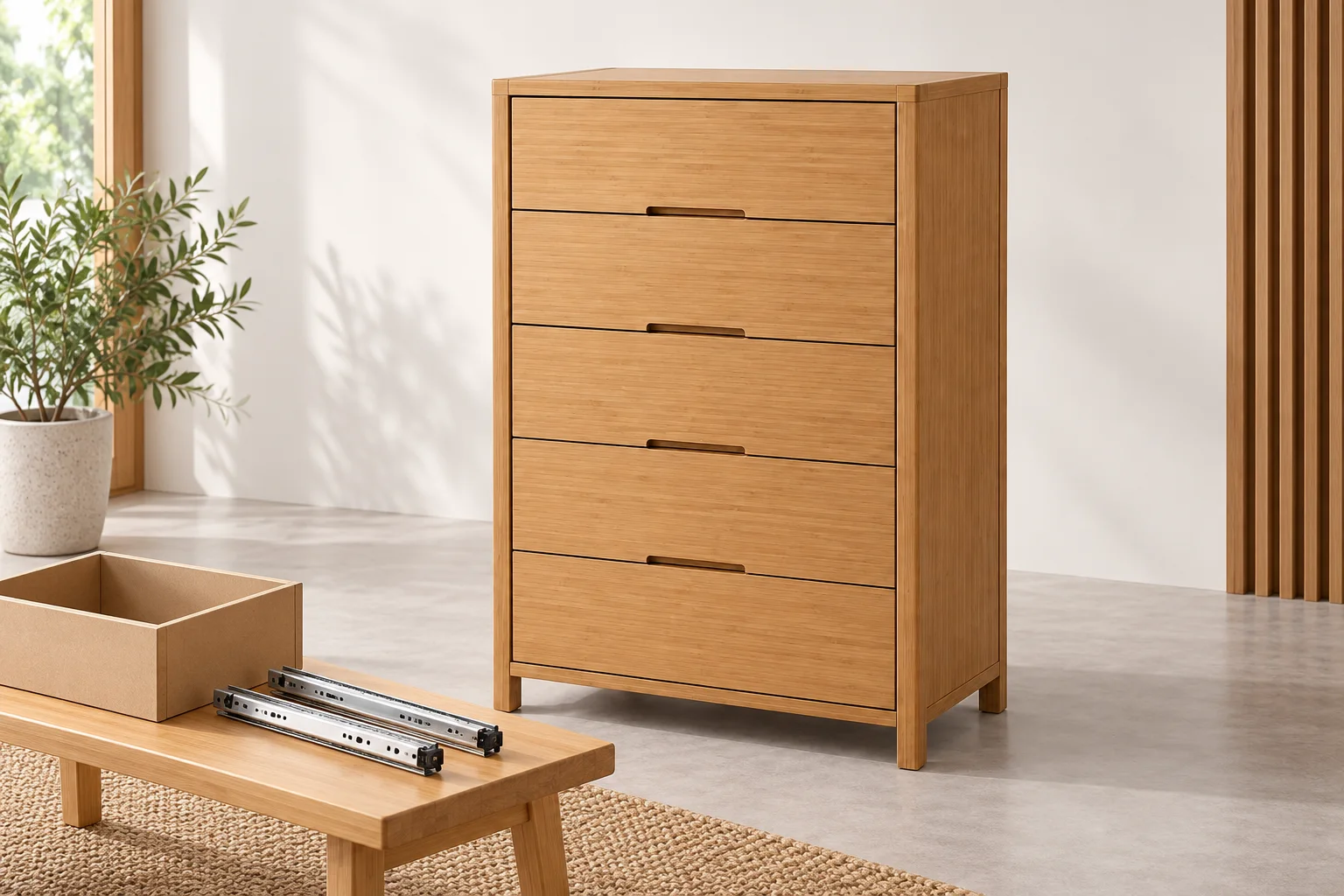
The five-drawer bamboo chest has five broad fronts with recessed pulls. The image supports a discussion of stacked storage, but it does not establish full extension, runner type, load rating or tool-free removal. Those details belong in the quotation and approved sample.
Choose the hardest item to retrieve: a box at the rear, a stack that cannot be tilted, or a removable organiser. Record its size, grip point and orientation. Agree the intended contents and loading with the supplier rather than using an arbitrary test weight.
Measure usable exposure at the normal stop
Ask for a side view showing internal drawer depth, normal travel, the part still under the cabinet top and the front projection into the room. Try retrieving the rear item without emptying the front section. Record the result, not merely the label “full extension”.
Compare options in the same intended room position. More travel may improve access while occupying more standing space. Decide whether the practical benefit warrants that footprint and any price difference.
Create a separate service-removal check
The drawer may open sufficiently for daily use yet need extra lift or release clearance for removal. Ask the supplier to demonstrate the selected system on an empty drawer in a safely supported sample unit. Observe the release locations, tools, lifting path and where the removed drawer can be placed.
Blum publishes separate runner assembly instructions for its systems. This is a useful reminder to request the actual selected hardware instructions; it does not imply this chest uses Blum hardware.
| Test | Evidence to capture | Accept or revise |
|---|---|---|
| Rear-item retrieval | Actual item reached at normal stop | No unplanned unloading or tilting |
| Open footprint | Front projection plus operator position | Fits the agreed working space |
| Removal | Supplier demonstration and tool list | Clear route and identified releases |
| Refit | Engagement and closing demonstrated | No unresolved alignment or retention issue |
Require a successful refit, not just extraction
After refitting, have the supplier show engagement, alignment and normal closing again. Record who may perform the procedure, any components replaced during service and the point at which work should be referred back. Do not prescribe a universal lever colour or pulling direction.
Keep this access record alongside the drawer contents brief and assembly documentation. A change of runner must trigger another access and removal review, even if the front appearance stays the same.
Send a decision-ready inquiry
Send the drawer product, difficult-to-reach item, room position and maintenance access constraints through our inquiry page. Request an option comparison based on retrieval and service demonstration, with hardware details confirmed separately.