
An access cover can remain visible above a cabinet while still being impossible to remove or service. The furniture decision should follow the full maintenance task: opening the cover, setting it down, reaching the component and putting everything back.
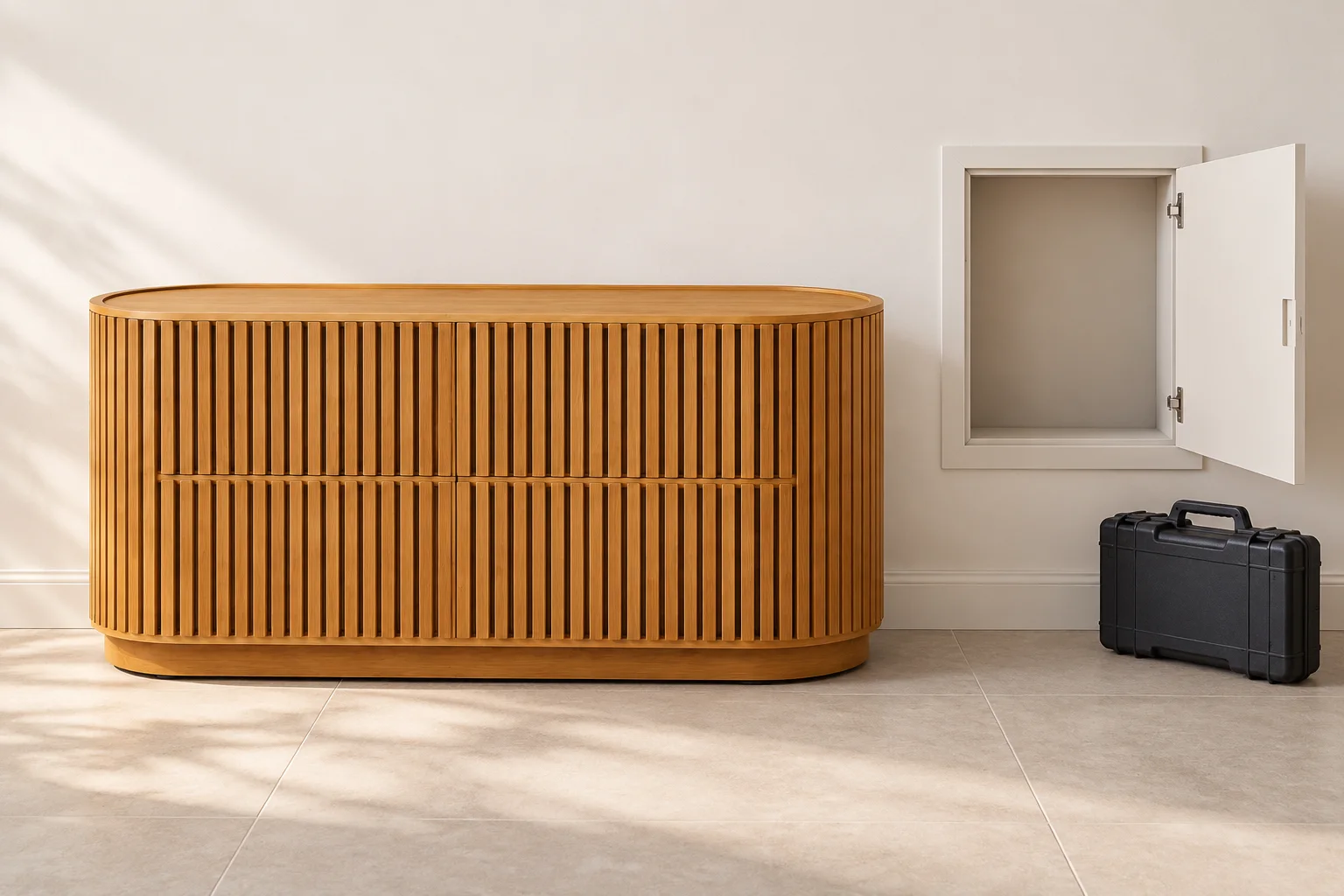
Identify what the panel serves
Ask the building team to identify the service, the responsible maintainer and the applicable access instructions. An unlabelled rectangle on an architectural elevation is not enough to specify the furniture around it. Keep life-safety and other specialist systems under the relevant designer’s review.
Record whether access is routine, occasional or required without first moving furniture. That distinction determines whether a proposed relocation procedure can even be considered.
Draw the cover outside its closed position
Ask the maintainer to show how the actual cover opens or comes off, including its handling position and the space needed to work. Do not assume that a flush cover slides upward, hinges outward or can be removed by one person.
Put the resulting access envelope on the furniture plan. Include the temporary location of removed parts and tools. The resulting area is a project-specific instruction, not a universal clearance dimension supplied by a furniture seller.
| Question | Evidence to obtain | Furniture consequence |
|---|---|---|
| What is behind the cover? | Building team identification | Assign the correct maintainer |
| How does the cover leave its opening? | Actual removal instructions | Keep that movement area clear |
| Where does the technician work? | Maintainer-reviewed access envelope | Revise furniture position if needed |
| May furniture be moved first? | Written site procedure and responsibility | Accept a defined move or choose another location |
A movable-looking sideboard is not an access method
The ribbed bamboo sideboard has a low, wide body and a recessed base. Its position may look easy to adjust in a rendering, but the picture does not establish its weight, a safe moving method or whether the installed version has additional restraints.
If the building team permits relocation before maintenance, specify who empties the cabinet, who moves it and where it waits. If that cannot be reliably arranged, revise the furniture position or design. Do not cut the cabinet back or alter the building cover on site without approved instructions.
Include one witnessed access check in handover
Use the approved maintainer procedure to verify the installed relationship before closing the interface item. Record the exact furniture position and the access document used. A photograph of the panel closed is useful for identification but does not prove the maintenance operation is available.
Send panel photographs, the maintainer’s access envelope and the proposed cabinet drawing with a bamboo cabinet enquiry. Review the cabinet and skirting-board interface separately; clearing a skirting board does not establish maintenance access.