
A record store listening station has two jobs that can conflict: supporting playback equipment and letting customers choose, handle and return records. Start with the listening routine before choosing a cabinet. A surface that fits the turntable may still leave someone holding an empty sleeve with nowhere to put it.
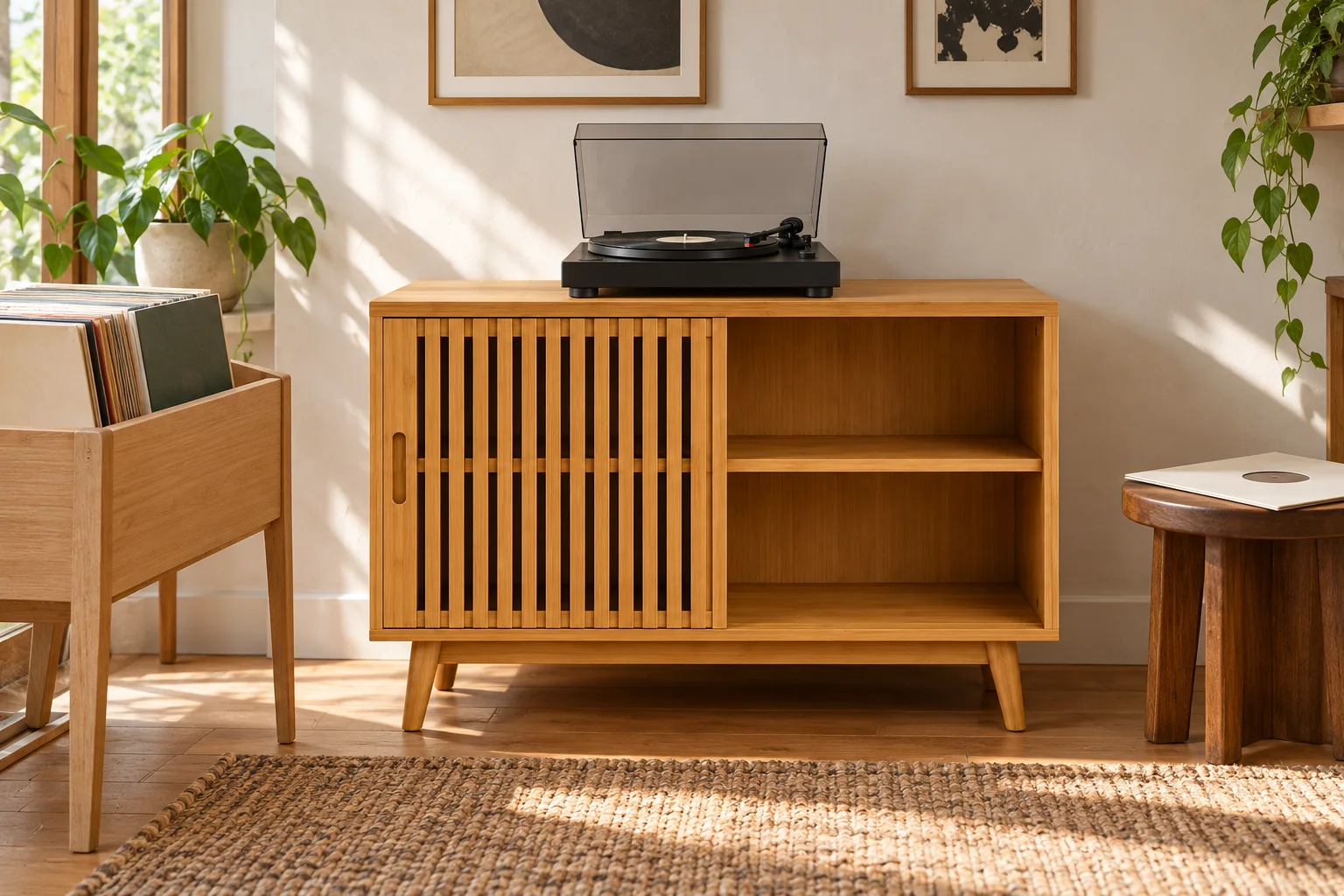
Separate the playback support from the browsing action
Place the proposed turntable position and the record-selection position on the same plan. Record which parts customers touch and which are operated by staff. Someone flipping through a tightly packed record bin should not have to lean against the furniture supporting the player. Keep that movement visible in the brief rather than treating all low storage as interchangeable.
Yamaha’s turntable-positioning guidance calls for a level, stable support and separation from speaker vibration. It is equipment guidance, not evidence that a particular bamboo cabinet provides vibration isolation. The final equipment supplier should confirm setup requirements for the actual player, speakers or headphones.
Give the sleeve a place during playback
Walk through one record from selection to return. The outer sleeve, inner sleeve and record do not all occupy the same place at the same time. Name a clean, dry sleeve landing surface that does not cover the player controls, obstruct its lid or require reaching over the platter. Keep drinks out of that working arrangement.
Decide whether the customer changes records or asks staff. A self-service arrangement needs its own operating instructions and equipment review. A staff-operated arrangement needs access from the staff side even when a customer is standing nearby. Neither arrangement is established by showing a turntable on a styled cabinet.
| Action | Place to identify | Trial to perform |
|---|---|---|
| Choose a record | A separate browsing bin or approved display | Browse while the playback support remains untouched |
| Set up playback | Player position and lid movement | Operate the controls with the intended equipment |
| Hold the sleeves | A clear dry landing surface | Put down both sleeves without covering controls |
| Finish listening | Agreed return location | Return the record without mixing it with an active selection |
Review an actual cabinet against the equipment
The bamboo sliding-door sideboard offers a low cabinet direction with covered and open storage. Its published appearance does not establish a turntable load rating, isolation performance or an equipment-ready compartment. Provide the player dimensions, weight, support-foot positions and operating clearance before discussing the top.
Show the lid fully open and the connected cables, including the space needed behind the cabinet. If an amplifier is to be housed inside, its manufacturer’s operating and ventilation requirements need a separate review. Do not add holes, mountings or electrical accessories to the order by assumption. Record storage, speaker supports and equipment supply should each have their own quotation line.
Try two users before fixing the layout
Use a mock-up with one person selecting a record while another follows the proposed listening sequence. This is a suggested purchasing trial, not a tested result. Note any contact with the playback support, blocked control or sleeve left in an unintended place. Change the location or furniture scope before asking for a finished sample.
For enclosed devices, use the media-equipment access checklist. To request a listening-station furniture review, send the equipment list, who operates it, sleeve and record-storage arrangement, room plan, finish reference and quantities. The OEM/ODM service scope can then be discussed against those inputs rather than an unverified promise about sound quality.