
Coworking storage starts with a membership decision: what may stay after the user leaves? A desk can be booked by several people over a week, while an assigned storage position remains occupied by one member’s belongings throughout that period. Counting cabinets from the number of desks alone mixes two different requirements.
Write the storage entitlement before selecting a cabinet
Record the rules for day users, recurring hot-desk members and dedicated-desk members. Better Space’s published FAQ distinguishes permission to leave a monitor at a dedicated desk from its clear-desk policy for other users. That is one operator’s arrangement, not a rule for every coworking business. Your own membership offer must determine the furniture brief.
Specify which belongings are accepted, how long a place may be reserved and who clears an expired allocation. If a member leaves a monitor at a dedicated desk, do not also count the same monitor as a daily cabinet-storage item. If all desks must be clear, show the physical destination for each permitted item rather than relying on a notice asking people to tidy up.
Count reserved positions separately from daily turnover
Consider a hypothetical operation with eight members assigned one overnight storage position each, plus a measured peak of six simultaneous day users who need separate positions. It needs fourteen positions under that policy even if some assigned members are absent. The example assumes one suitable position per user; it is not a cabinet capacity or a recommendation about demand.
If the business wants unoccupied assigned space to be reused, the access and reservation policy must explicitly allow that. Do not silently reduce the furniture quantity by assuming access to someone else’s allocated compartment. Use actual attendance and storage observations when available, and identify an estimate as an estimate when planning a new site.
| User or item | Question to settle | Count separately |
|---|---|---|
| Assigned member storage | Does the place remain reserved overnight? | All reserved positions |
| Day-use belongings | How many users need storage at the same time? | Peak simultaneous day-use positions |
| Shared office supplies | Who accesses and replenishes them? | Operator-controlled storage |
| Items left after expiry | Who handles the exception? | An agreed operator process, not another member’s space |
Choose open storage or controlled access deliberately
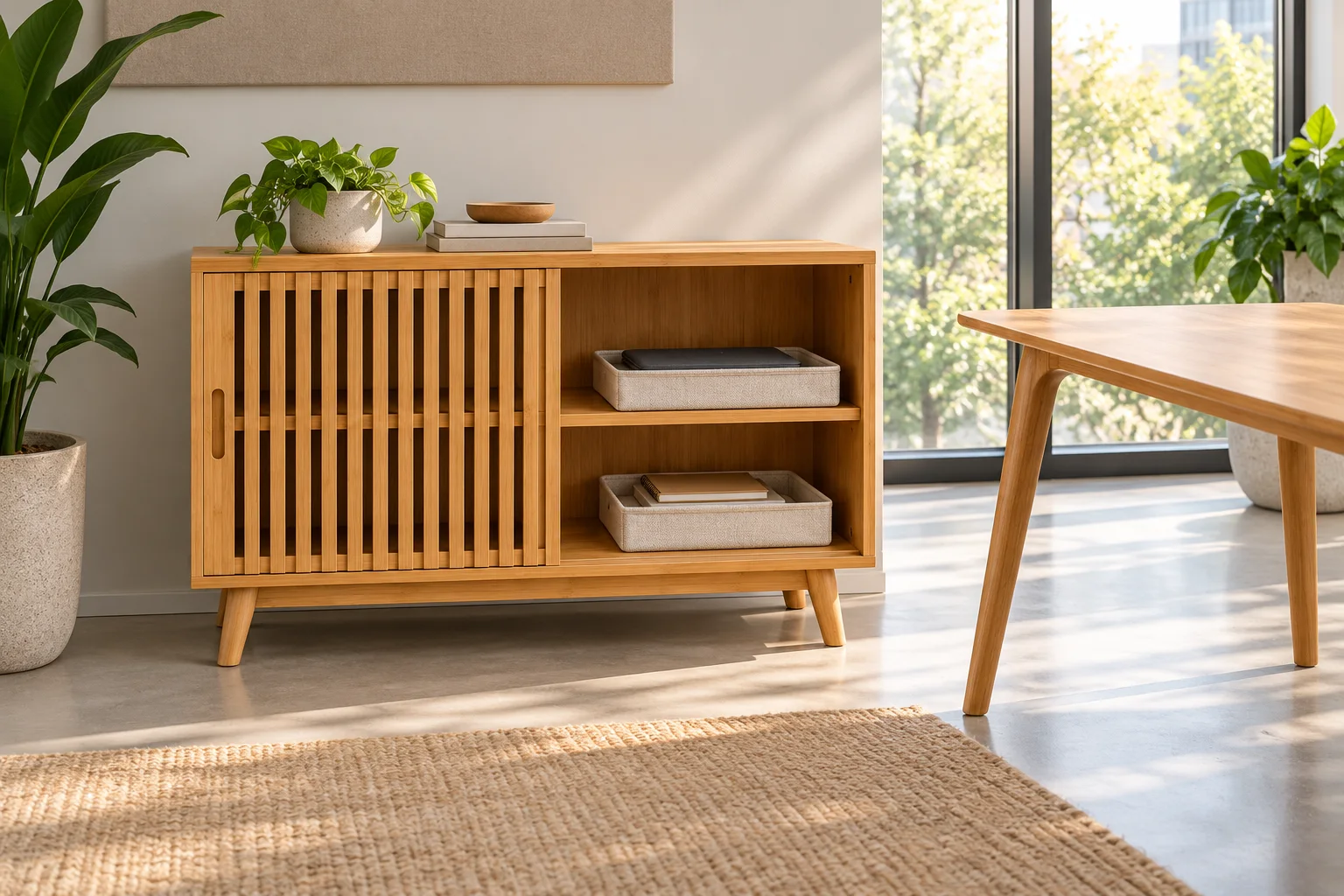
The bamboo sliding-door sideboard combines open and covered storage. It may provide a furniture direction for agreed low-risk belongings or shared supplies, but a sliding door is not evidence of secure individual custody. If members require individually controlled access, define that requirement and request an appropriate confirmed solution. Do not present an open tray as a locker.
Measure the permitted contents together: a laptop inside its sleeve, a notebook and any bag intended to accompany them. A shallow personal tray and a bag compartment are different allocations. Ask which containers are included, how they are identified and whether the cabinet opening lets one be removed without disturbing the next.
Check the desk-to-storage handover
Try closing time with the planned number of users. Someone should be able to clear a desk, access their assigned place and leave without putting belongings on another bookable desk. On reopening, check that the furniture and the membership record point to the same available spaces. A cabinet door hiding clutter does not resolve ownership.
A bamboo table can illustrate the separate work surface; it is a dining-table reference whose proposed office use needs project review. For actual locked compartments, see the key-arrangement questions. Send a coworking storage enquiry with the membership rules, allocation counts, contents, access requirements and plan, then define the furniture supply scope without assuming lockers, security ratings or electronics are included.