
Book display shelving needs two capacity numbers: how many titles a visitor can see face-on, and how many physical copies the arrangement stores. A cover-facing book can occupy the frontage used by several spine-facing books. Counting the shelf once as full storage and again as display overstates what the same space can do.
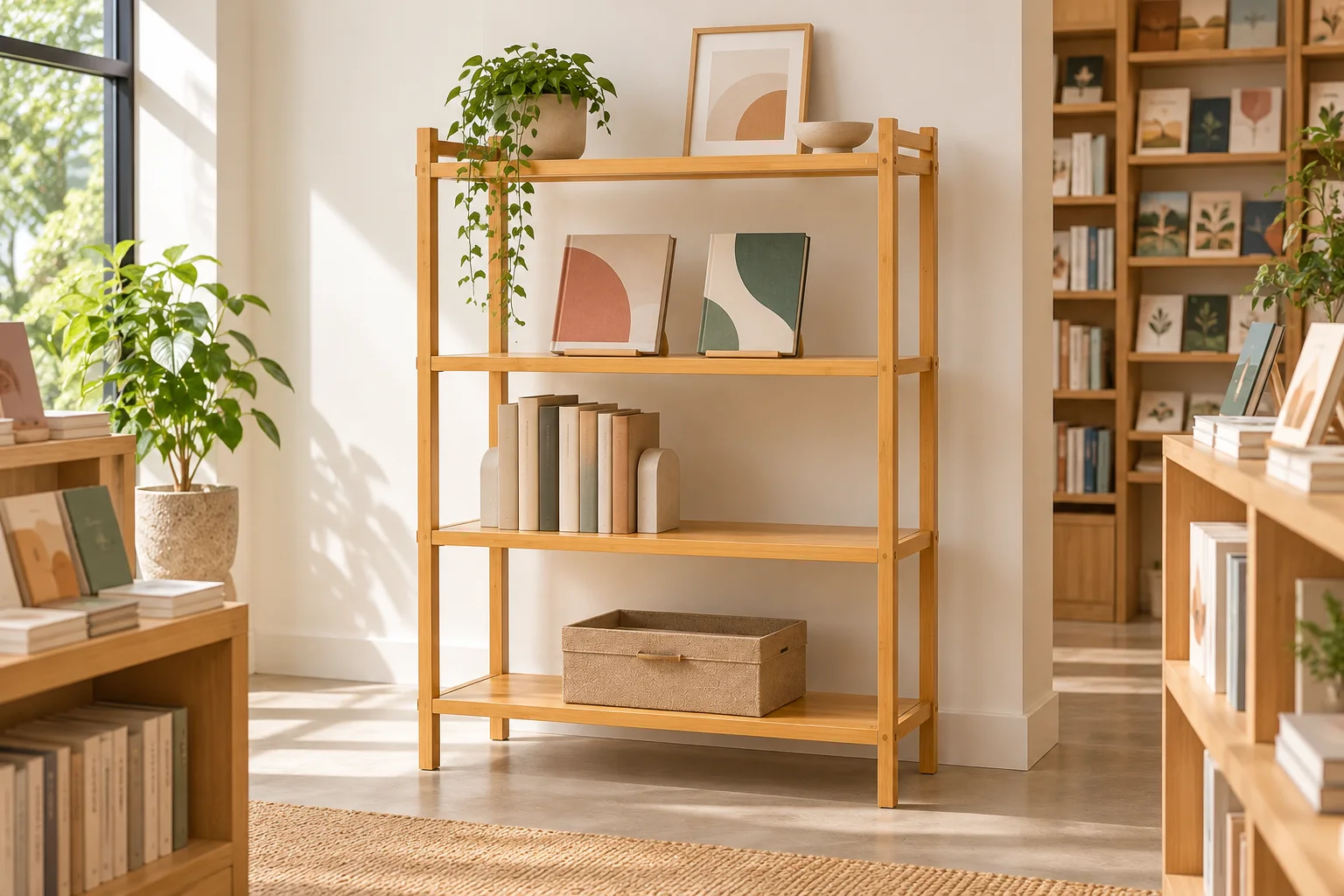
Separate visible titles from stored copies
Write the display objective first. Is the shelf meant to show selected new titles, hold a full category, or combine a small display with sale stock? A displayed title may have several copies elsewhere, but that does not create additional visible facings. Conversely, two copies of the same title shown face-out use two physical positions even though the range still contains one title.
LFI’s shelving-capacity document gives separate estimates for flat shelves and face-out display on its own furniture. Those figures cannot be transferred to a bamboo shelving reference. The useful distinction is between display mode and storage mode; calculate your proposal from your actual books and approved usable shelf dimensions.
Use a mixed-shelf example without counting the space twice
Take a hypothetical shelf with 900 mm of usable frontage. Suppose two face-out positions each use 220 mm, with another 40 mm allocated to the particular supports and gaps in this example. That leaves 420 mm for the remaining arrangement. If the selected spine-out books are each 30 mm thick, fourteen is the mathematical upper bound before any further bookend, hand-access or adjustment allowance.
This arithmetic is not a product dimension or an accepted capacity of fourteen books. Measure the chosen supports and test removal; the usable result may be lower. The two displayed copies must not also be counted as occupying the remaining 420 mm. If extra copies sit behind a facing, include their depth and retrieval method explicitly instead of adding invisible stock to the count.
| Measure | Count or record | Do not substitute |
|---|---|---|
| Visible facings | Physical cover-forward positions | Number of titles in the whole collection |
| Stored copies | Every physical copy and its location | An image of a full shelf |
| Usable frontage | Clear width minus supports and agreed gaps | Outside furniture width |
| Working capacity | Arrangement with books removable | Theoretical division with no access allowance |
Test the largest book and the changing assortment
Use representative paperbacks, hardbacks and any larger-format books you actually sell. Check the shelf height with the display support in place, not just the book standing flat on the surface. Ask whether a cover remains visible when a neighboring book is removed, and whether the end of a spine-out row stays supported as stock sells down.
Plan what happens when a displayed title is sold or replaced. If the replacement format is wider, the same number of facings may no longer fit. Record the intended format range and the parts that can be rearranged. Do not promise an adjustable display or removable fittings until that construction has been agreed.
Turn the layout into a shelving enquiry
The Contemporary Bamboo Open Shelving Unit provides an open-frame design direction with project-reviewed shelf spacing and loading. Bookends, display stands, tilted inserts and retaining parts must be specified separately; they are not automatically included. Loaded book weight and its distribution also require review even when the books fit by width.
Keep the clear-opening measurements beside the display calculation. Where the shop also serves drinks, the bookstore cafe layout guide covers the separate browsing and reading arrangement. For a book display shelving enquiry, send sample book sizes and weights, facing targets, stock-copy counts, proposed supports and a shelf-by-shelf sketch. Then confirm the furniture and accessory supply scope without treating another manufacturer’s capacity table as your specification.